
Wired vs. Wireless Headphones: What Actually Changes Beyond the Cable
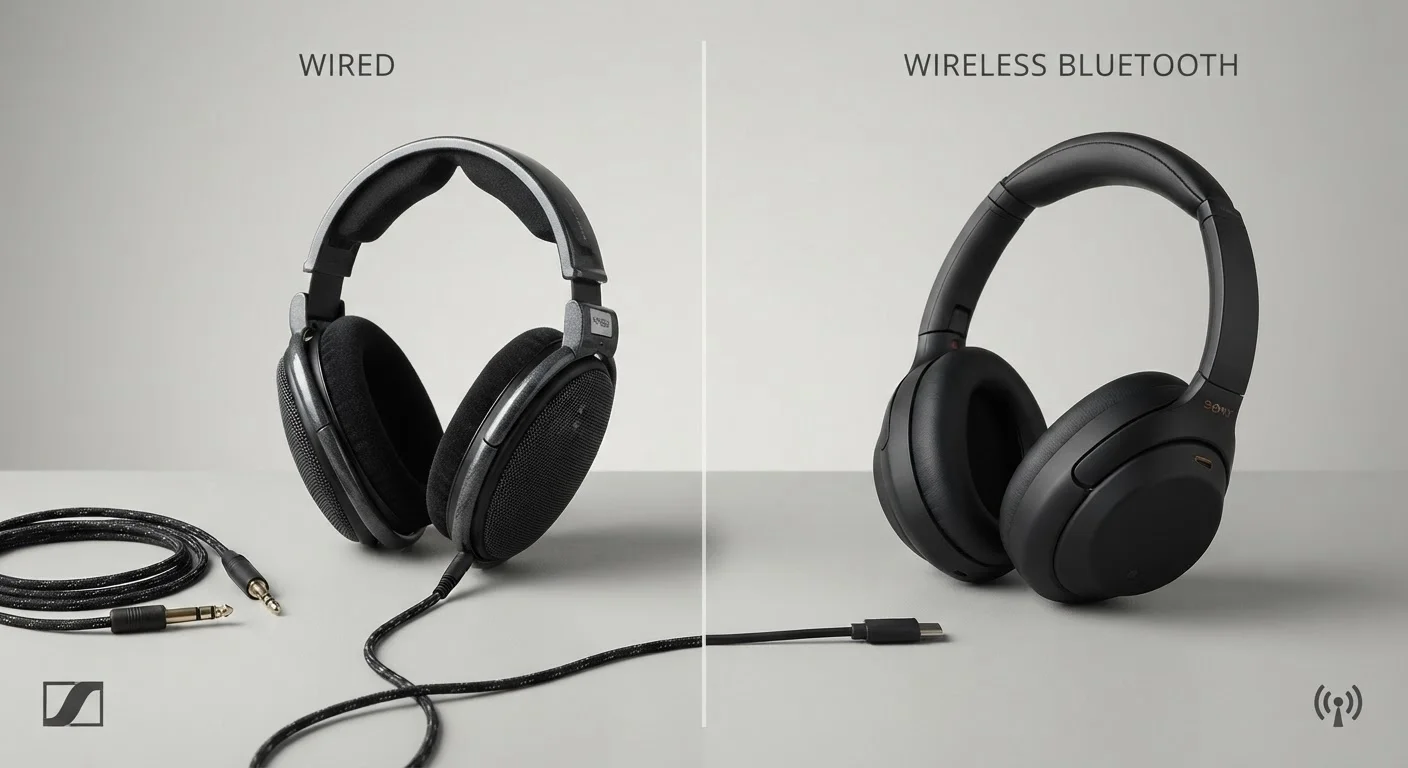
Photo credit: ProximityFinds.com | One-stop Reading Source
In this article
It's not just about convenience. Latency, audio quality, battery life, and codec support all shift when you go wireless. Here's what that means in practice.
Key Takeaways
- Wired headphones deliver audio via analog signal with no encoding delay or compression artifacts.
- Wireless headphones rely on Bluetooth codecs that introduce latency and can affect audio quality depending on the codec used.
- Battery life is a genuine constraint for wireless; wired headphones draw power directly from the source.
- Active Noise Cancellation (ANC) and smart features are nearly exclusive to wireless models today.
- High-impedance wired headphones may require a dedicated amplifier to sound their best.
- Neither format is universally superior - the right choice depends on your primary use case.
The Signal Path: Analog vs. Encoded Wireless
The most fundamental difference between wired and wireless headphones isn't the cord - it's how audio data travels from your device to your ears.
Wired headphones receive an analog electrical signal directly from the source. That signal is converted into sound by the driver without any intermediate processing step. The result is a straightforward, low-latency path that preserves whatever the source outputs.
Wireless headphones - nearly all of which use Bluetooth - work differently. Your device encodes the audio into a digital packet using a codec (short for coder-decoder), transmits it wirelessly, and the headphones decode it back into an audio signal. Common codecs include SBC (the universal baseline), AAC (widely used on Apple devices), aptX and aptX HD (common on Android), and Sony's LDAC, which transmits at the highest bitrate of any widely available consumer Bluetooth codec.
Each encoding step introduces latency - the delay between a sound event and when you hear it - and potential quality trade-offs depending on the codec. SBC, for instance, is lossy and relatively low bitrate. LDAC can approach near-lossless quality at 990 kbps, though it requires both the source device and headphones to support it. To understand how specifications like frequency response and SNR interact with these differences, see our plain-English guide to audio specs.
| Criterion | Wired Headphones | Wireless Headphones |
|---|---|---|
| Signal path | Direct analog, no encoding | Bluetooth codec (SBC, AAC, aptX, LDAC) |
| Latency | Effectively zero | ~30-200ms depending on codec |
| Audio quality ceiling | Limited only by source and hardware | Codec-dependent; LDAC approaches lossless |
| Battery required | No | Yes (typically 20-35 hours per charge) |
| Active Noise Cancellation | Rarely available | Common at mid-to-upper price points |
| Mobility | Cable-constrained | Full freedom of movement |
| Smart features (voice assistants, touch controls) | Uncommon | Standard on most modern models |
| Gaming suitability | Excellent (zero latency) | Moderate (latency may cause desync) |
Latency, Battery, and the Features That Come With Wireless
Latency is one of the most practical distinctions. Wired headphones operate in real time - latency is effectively zero for human perception. Bluetooth introduces a delay that typically ranges from roughly 30ms to 200ms depending on codec and implementation. For music listening, this is rarely noticeable. For video, it can cause slight lip-sync drift. For gaming, it becomes a meaningful disadvantage.
~30ms
Typical aptX Low Latency Bluetooth delay
aptX LL is among the lowest-latency consumer Bluetooth codecs, though device support varies widely across the US market.
990 kbps
Peak LDAC transmission bitrate
Sony's LDAC codec transmits at up to 990 kbps - substantially higher than SBC's typical 328 kbps ceiling - when signal conditions allow.
20-35 hrs
Typical wireless over-ear battery life
Most over-ear wireless headphones on the US market achieve this range per charge; ANC use generally reduces it by 20-30%.
On the feature side, wireless headphones have become the primary home for Active Noise Cancellation (ANC) - technology that uses onboard microphones to generate an anti-noise signal that reduces ambient sound. ANC requires dedicated processing hardware and battery power, which is why it's effectively absent from wired headphones at most consumer price points.
Battery life introduces a management obligation that wired headphones simply don't have. Most over-ear wireless headphones deliver 20-35 hours of use per charge, with ANC reducing that figure. Wired headphones draw minimal power - or none at all if the source is passive - and will never die mid-commute.
Bluetooth connectivity itself has its own nuances. For a grounded look at what version numbers actually change in practice, our Bluetooth versions decoded breaks down what each generation genuinely affects.
Codec Compatibility Requires Both Ends
A headphone advertising LDAC or aptX HD support only delivers that quality when the source device also supports the same codec. iPhones, for example, support AAC but not aptX or LDAC natively, so those codecs won't activate regardless of headphone capability. Check both your device and headphone specifications before assuming a specific codec will be used.
Which Headphone Type Fits Your Actual Listening Life
Neither format is categorically better. The right choice maps to how and where you listen.
Wired headphones remain the standard in professional audio work - recording studios, broadcast, and critical listening environments - because codec-free delivery eliminates variables. High-impedance wired models (those rated above 100 ohms) may require a dedicated headphone amplifier or DAC (digital-to-analog converter) to reach their full potential. If your phone or laptop has dropped its 3.5mm headphone jack, you'll also need a USB-C or Lightning adapter, which adds a minor but real friction point.
Wireless headphones have closed the audio quality gap considerably at mid-to-upper price points, particularly with LDAC and aptX HD codec support. For the majority of casual and even enthusiast listeners, the difference from a high-quality wired connection is difficult to detect in everyday use. The practical additions - ANC, call microphones, gesture controls, and wear detection - address real daily needs.
Port transitions have made this conversation more relevant than ever. If you're sorting out the broader connectivity picture - including which audio ports and adapters are worth understanding - our guide to electronics cords and ports covers the landscape clearly.
For most everyday Americans, wireless headphones now offer a capable, convenient experience. For those who want zero signal compromise or need latency-free performance for gaming or professional monitoring, wired remains the technically straightforward choice.

Author
Technology Editorial Team
Technology Editorial Team is the collective byline for our editorial team and contributor network. Articles published under this byline or an editorial pen name are researched, written, and reviewed according to our editorial standards for clarity, consistency, and independence before publication.
View all articles →