
Budgeting Methods Compared: Envelope, App-Based, and Spreadsheet Approaches
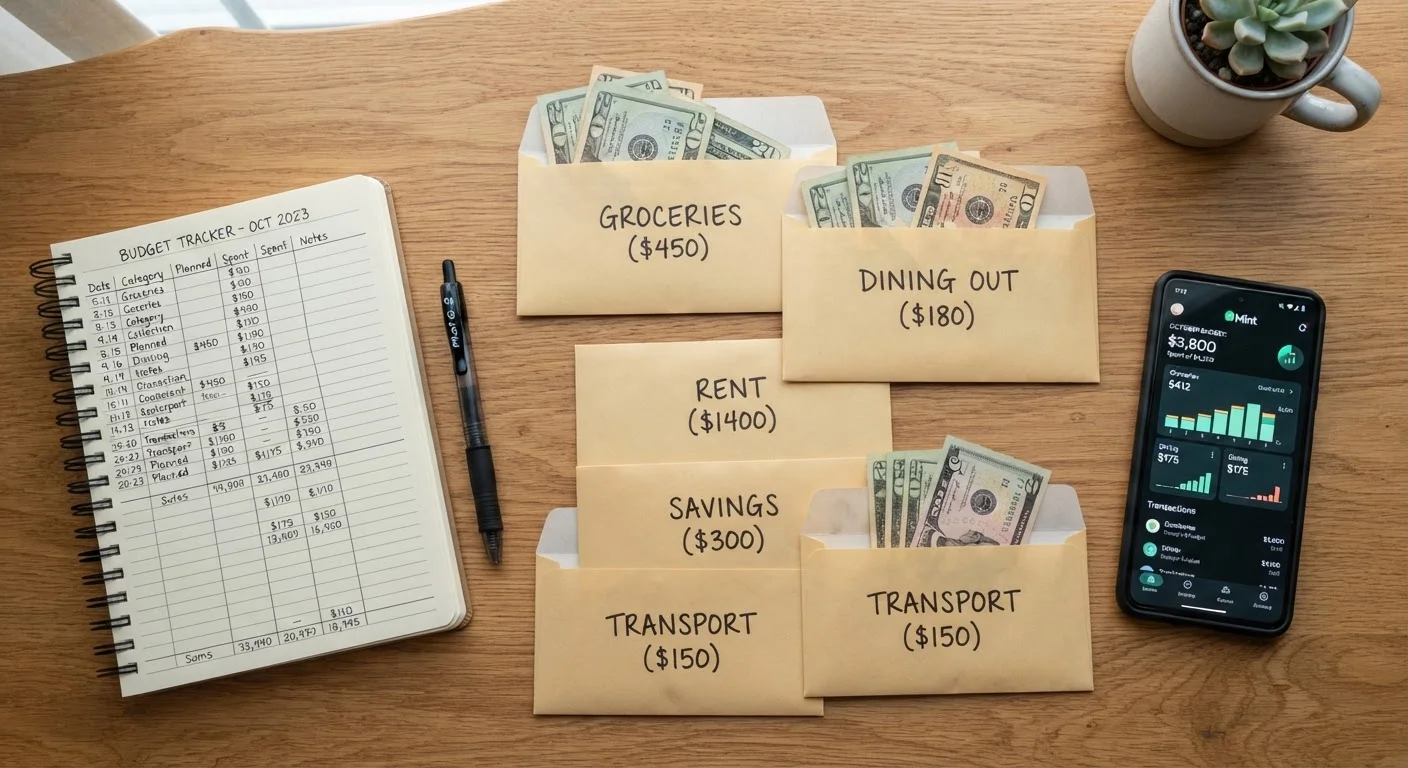
Photo credit: ProximityFinds.com | One-stop Reading Source
In this article
Envelope cash budgeting, digital apps, and spreadsheets each have real trade-offs. See how these three approaches stack up for everyday use.
Key Takeaways
- Envelope budgeting uses physical cash to enforce hard spending limits and curb impulse purchases.
- App-based budgeting offers automation and real-time tracking but requires sharing financial account access.
- Spreadsheet budgeting gives maximum flexibility and control, but demands consistent manual upkeep.
- The best method is the one you'll actually use consistently month after month.
- Many people combine elements of two methods to match their specific financial habits.
Why Your Budgeting Method Matters
A budget is only as effective as the system supporting it. You might follow the 50/30/20 rule or zero-based budgeting framework perfectly on paper, but if your tracking method doesn't fit your habits, the whole plan breaks down by week two. The three most widely used approaches-envelope cash budgeting, app-based tools, and spreadsheets-each reflect a different philosophy about how people best manage money. Understanding their trade-offs helps you choose the method most likely to stick.
If you're new to the concept entirely, it helps to first build a foundation. See our primer on personal budgeting fundamentals before deciding which tracking method to adopt.
Envelope Budgeting: Tangible Control Over Spending
The envelope method involves withdrawing cash at the start of each budget period and dividing it into labeled envelopes-one for groceries, one for dining out, one for entertainment, and so on. When an envelope is empty, spending in that category stops until the next period.
The psychological power here is real: studies in consumer behavior consistently show that people spend less when paying with cash compared to cards, because the physical act of handing over money makes the cost feel more immediate. For anyone struggling with overspending in specific categories, this friction is a feature, not a bug.
Key advantages:
- No technology required-accessible to anyone
- Creates a visceral, real-time awareness of remaining funds
- Eliminates the risk of overdraft or overspending within a category
Limitations:
- Impractical for online purchases, recurring subscriptions, or bill autopay
- Carrying cash poses a safety and loss risk
- Doesn't automatically track historical spending patterns
Hybrid Envelope Approach for Digital Spenders
If you primarily pay with cards or online, consider a 'virtual envelope' system: allocate specific dollar amounts to categories in a notes app or simple ledger, then manually deduct each purchase. You get the discipline of envelope thinking without needing to carry cash. This works especially well for two or three categories where you tend to overspend.
App-Based Budgeting: Automation and Real-Time Insight
Budgeting apps connect directly to your bank accounts and credit cards, automatically categorizing transactions and updating your budget in near real time. This removes the manual logging burden and gives you a consolidated view of spending across all accounts.
For households juggling multiple income streams or accounts-common for couples managing shared finances-apps offer a convenient single dashboard. Most modern budgeting apps also send alerts when you approach a category limit.
Key advantages:
- Automatic transaction syncing reduces manual data entry
- Works seamlessly with digital payments and subscriptions
- Visualizations and reports make trends easy to spot
Limitations:
- Requires granting third-party access to financial account credentials
- Auto-categorization errors still require periodic review
- Subscription fees apply to some platforms; free versions may have feature limits
Understand the Privacy Trade-Off
Budgeting apps that link directly to your bank accounts require you to share financial credentials or authorize account access through a data aggregator. Before connecting accounts, review the app's data-sharing and security policies carefully. No budgeting tool is worth compromising the security of your primary financial accounts.
Spreadsheet Budgeting: Full Control, Full Responsibility
A budgeting spreadsheet-whether built in a free tool or a paid application-gives you a blank canvas to design exactly the tracking system you want. You define the categories, formulas, and layout. Nothing is pre-set or automated unless you build it yourself.
This approach suits people who enjoy working with numbers and want granular visibility into their finances. It also pairs naturally with frameworks that require detailed allocation, such as zero-based budgeting, where every dollar of income is assigned a specific purpose. For help building one from the ground up, our guide to setting up your first monthly budget walks through the process step by step.
Key advantages:
- Fully customizable to any income structure or spending pattern
- No account linking required-privacy is preserved
- Free tools are widely available and capable
Limitations:
- Every transaction must be entered manually to stay accurate
- Requires time investment to build and maintain
- Errors in formulas can silently distort your picture
| Envelope | App-Based | Spreadsheet | |
|---|---|---|---|
| Setup effort | Low - cash and envelopes only | Low - account linking required | High - must build from scratch |
| Ongoing maintenance | Manual cash handling each period | Mostly automated with periodic review | Full manual entry every transaction |
| Works with digital payments | No - cash only | Yes - fully compatible | Yes - manual entry required |
| Privacy / data sharing | No data exposure | Account credentials shared | No data exposure |
| Customization | Limited to cash categories | Moderate - preset categories | Unlimited - fully custom |
| Cost | Free | Free to paid tiers | Free tools widely available |
| Best for overspenders | Yes - enforces hard limits | Moderate - alerts only | Depends on self-discipline |
Choosing the Right Method-and Sticking With It
The most effective budgeting method is the one you'll actually maintain. A sophisticated app does nothing if you ignore its alerts; a spreadsheet fails if you stop updating it after day three. Honest self-assessment about your habits-how disciplined you are with cash, how comfortable you are with technology, how much time you'll realistically invest-is the most important input in this decision.
It's also worth noting that methods can be layered. Some people use an app for overall tracking while applying envelope-style limits to problem categories like dining or entertainment. Others use a spreadsheet for monthly planning and a simple app for daily check-ins.
Whatever method you choose, build in a regular review. Our monthly budget audit checklist helps you evaluate what's working and course-correct before small slips become larger problems. Also make sure your budget accounts for the full range of expense categories people commonly miss, regardless of which tracking method you use.
This article is for general informational and educational purposes only and does not constitute personalized financial advice. Consider consulting a qualified financial professional for guidance specific to your situation.

Author
Finance Editorial Team
Finance Editorial Team is the collective byline for our editorial team and contributor network. Articles published under this byline or an editorial pen name are researched, written, and reviewed according to our editorial standards for clarity, consistency, and independence before publication.
View all articles →