
All-Wheel Drive, Four-Wheel Drive, and Front-Wheel Drive: A Driver's Comparison
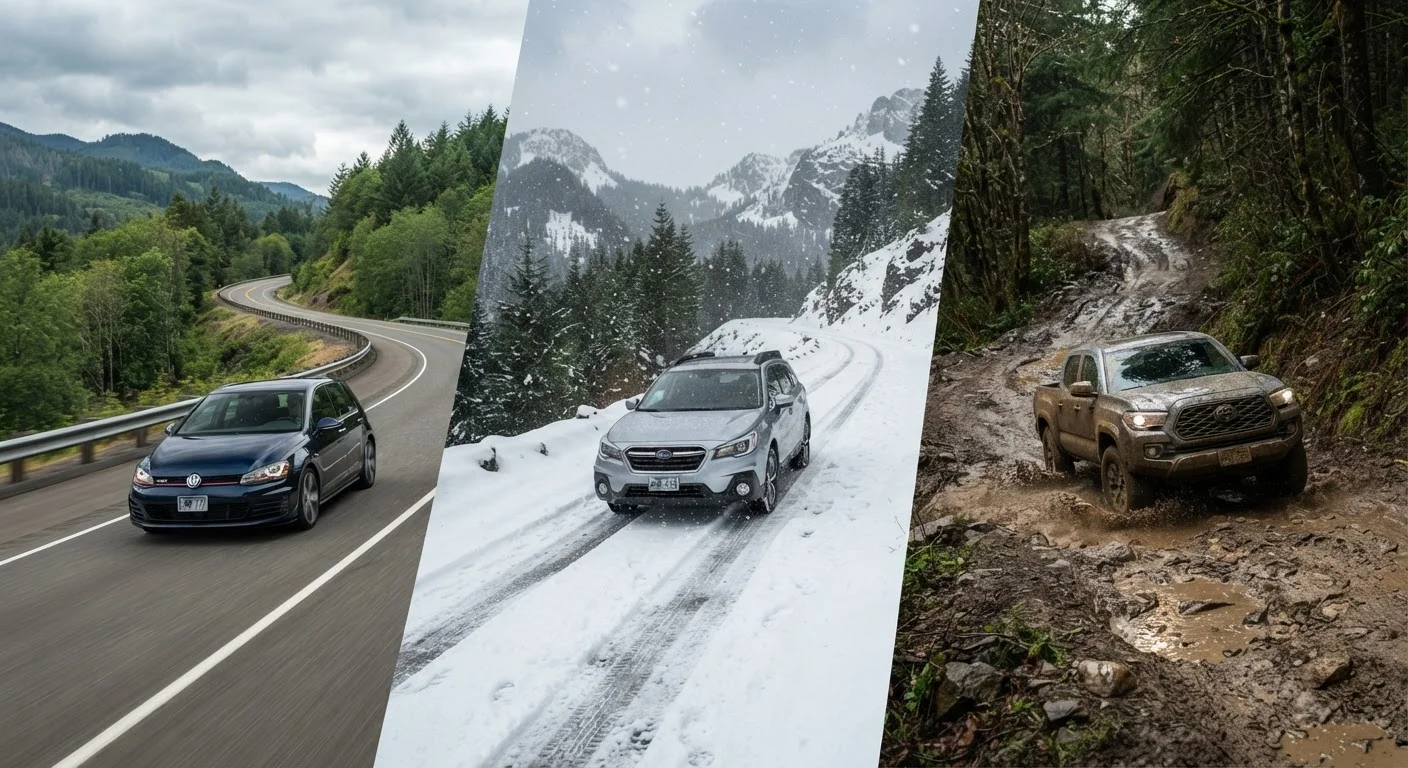
Photo credit: ProximityFinds.com | One-stop Reading Source
In this article
Understand the mechanical differences between AWD, 4WD, and FWD and which driving conditions each is designed to handle.
Key Takeaways
- FWD sends power only to the front wheels, making it efficient and practical for everyday driving on paved roads.
- AWD automatically distributes power to all four wheels and works best on slippery or unpredictable surfaces.
- 4WD is a driver-selectable system built for serious off-road or deep-snow conditions, typically found on trucks and body-on-frame SUVs.
- No drivetrain system replaces proper tires or safe driving habits - all three have braking and handling limits.
- Fuel economy and vehicle cost generally favor FWD, while AWD and 4WD add mechanical complexity and weight.
What Each Drivetrain Actually Does
Drivetrain - the system that delivers engine power to the wheels - comes in three main flavors for passenger vehicles: front-wheel drive (FWD), all-wheel drive (AWD), and four-wheel drive (4WD). Each routes power differently, and those differences have real consequences for how your car handles rain, snow, mud, and everyday roads.
Front-wheel drive sends all engine power exclusively to the two front wheels. Those wheels handle both steering and propulsion, which simplifies the mechanical layout and reduces vehicle weight. Most sedans, minivans, and compact crossovers use FWD.
All-wheel drive uses a center differential or electronic clutch system to send power to all four wheels simultaneously. Some systems do this full-time; others operate primarily in two-wheel drive and automatically engage the other axle when sensors detect wheel slip. AWD requires no driver input - it manages itself.
Four-wheel drive is a manually selectable system (via a lever, button, or dial) that locks front and rear axles together at a fixed power split, typically 50/50. Many 4WD-equipped trucks and traditional SUVs also offer a low-range setting (4L) for extreme off-road situations. Unlike AWD, 4WD is generally not designed to stay engaged on dry, hard pavement - doing so can stress drivetrain components. To understand how power management relates to your vehicle's overall mechanical picture, see our guide on how transmissions work.
| FWD | AWD | 4WD | |
|---|---|---|---|
| Power delivery | Front wheels only | All four wheels (automatic) | All four wheels (driver-selected) |
| Best conditions | Dry/wet pavement | Mixed weather, light snow | Off-road, deep snow, mud |
| Driver input required | None | None - fully automatic | Yes - engage/disengage manually |
| Fuel economy impact | Best | Moderate reduction | Larger reduction |
| Mechanical complexity | Low | Moderate | High |
| Improves braking? | No | No | No |
| Typical vehicles | Sedans, compact crossovers | Crossovers, SUVs | Pickup trucks, body-on-frame SUVs |
Where Each System Shines - and Where It Doesn't
Understanding the conditions each drivetrain is built for helps set realistic expectations.
FWD: Built for Efficiency
FWD vehicles perform well on dry and wet pavement, are generally lighter, and deliver better fuel economy than comparable AWD or 4WD vehicles. The front-engine, front-drive layout also maximizes interior space. The trade-off: in deep snow or on loose terrain, FWD can struggle once the front wheels lose traction. Understeer - where the car tends to push wide in corners - is also more common with FWD in demanding situations.
AWD: All-Conditions Confidence
AWD earns its reputation in mixed or unpredictable weather. By redistributing torque to wheels that have grip, it helps maintain forward momentum on slick roads. It's particularly well-suited to daily driving in snowy or rainy climates. However, AWD does not improve braking distances - it only helps with acceleration and directional stability. For a fuller picture of how road conditions change what your vehicle can do, check out driving in rain, fog, and snow.
4WD: Serious Off-Road Capability
4WD excels where AWD is outmatched - deep mud, rock crawling, sand, and severe off-road trails. The added low-range gearing multiplies torque for slow, technical driving. On dry pavement, however, engaging 4WD can create binding in the drivetrain, so it should be reserved for the conditions it was designed for.
Winter Tires Beat Drivetrain Alone
If you live in a region with genuine winter conditions, dedicated winter tires are one of the most impactful upgrades you can make - regardless of drivetrain. Winter tires use a softer rubber compound and specialized tread patterns designed to grip in cold temperatures and on snow and ice. An FWD car on winter tires routinely outperforms AWD vehicles on all-season tires in braking and cornering on snow.
Traction Isn't the Whole Safety Picture
A common misconception is that AWD or 4WD makes a vehicle inherently safer in bad weather. Both systems help you get moving and stay directionally stable - but neither shortens your stopping distance. Braking is determined by your tires, brake system, and road surface, not your drivetrain. The stopping distance of an AWD SUV on ice is virtually identical to that of an FWD sedan on the same ice with the same tires.
This is why tire choice matters as much as drivetrain choice. A front-wheel drive car on winter tires will often outperform an AWD vehicle on all-season tires in true winter conditions. For more on how your stopping hardware works, see disc brakes vs. drum brakes.
~5-10%
Fuel economy reduction with AWD vs. FWD
The U.S. Department of Energy notes that AWD systems typically reduce fuel economy by roughly 5-10% compared to equivalent FWD vehicles due to added weight and drivetrain drag.
Same
Stopping distance: AWD vs. FWD on ice
Drivetrain type does not affect braking distance - stopping power is determined by tires and brakes, not whether a vehicle is AWD or FWD.
Cost, Complexity, and Long-Term Ownership
Drivetrain choice affects your wallet beyond the sticker price. AWD and 4WD systems add mechanical components - additional differentials, transfer cases, driveshafts - that increase purchase price, reduce fuel economy, and introduce additional maintenance points over time. Service intervals for transfer cases and rear differentials add to ownership costs that FWD vehicles avoid entirely.
FWD vehicles are generally the most affordable to buy and maintain, with simpler drivetrain layouts that have fewer parts to service. AWD vehicles occupy a middle ground - more complex than FWD but often more manageable than traditional 4WD truck-based systems. If your driving is primarily urban or suburban on paved roads, the added expense of AWD or 4WD may not deliver a proportional benefit. For those in consistently icy or snowy regions, or who regularly venture onto unpaved roads, the investment can be well justified. Understanding your actual driving patterns - not an aspirational version of them - is the most practical guide to the right choice.
This article is for general informational purposes only. Drivetrain performance varies by vehicle model, tire type, road conditions, and driver behavior. Always consult your owner's manual and a qualified mechanic for guidance specific to your vehicle.

Author
Automotive Editorial Team
Automotive Editorial Team is the collective byline for our editorial team and contributor network. Articles published under this byline or an editorial pen name are researched, written, and reviewed according to our editorial standards for clarity, consistency, and independence before publication.
View all articles →