
Driving in Rain, Fog, and Snow: How Conditions Change What Your Car Can Actually Do
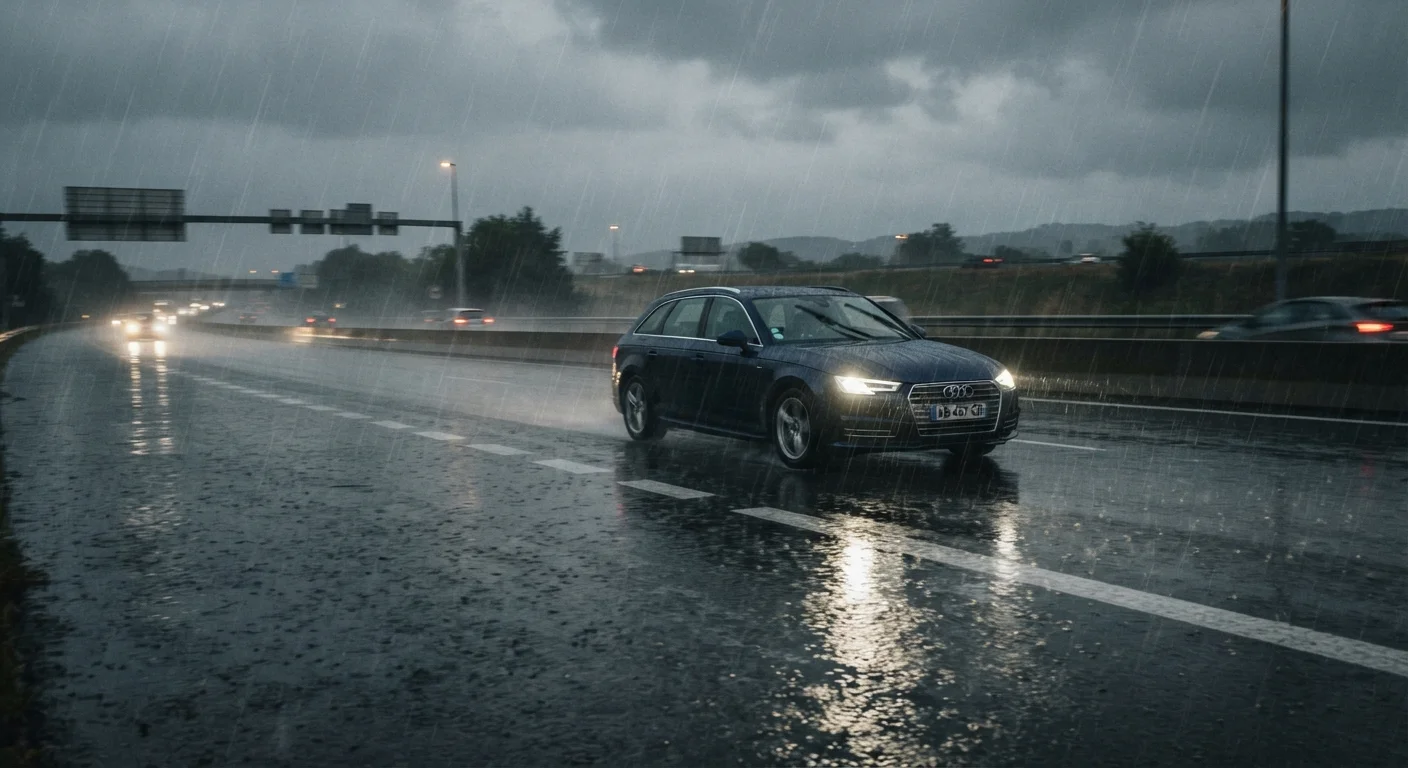
Photo credit: ProximityFinds.com | One-stop Reading Source
In this article
Wet roads, reduced visibility, and ice all affect braking, steering, and traction differently. Here's how to adjust your driving for each.
Key Takeaways
- Wet roads can double your stopping distance compared to dry pavement.
- Fog requires slower speeds and low-beam headlights - high beams make visibility worse by reflecting off moisture.
- Snow and ice demand earlier, gentler braking and steering inputs than most drivers expect.
- AWD and 4WD help you accelerate in slippery conditions but do not shorten your stopping distance.
- Tire tread depth is one of the biggest factors in how your car handles any adverse condition.
- Slowing down is the single most effective adjustment you can make in any type of bad weather.
What Changes When the Road Surface Changes
Your car's ability to stop, turn, and accelerate all depend on friction - the grip between your tires and the road. Under ideal conditions on dry pavement, that grip is relatively predictable. The moment rain, snow, or ice enters the picture, that friction drops, sometimes dramatically, and your vehicle's behavior changes with it.
Most drivers understand this in theory but underestimate it in practice. The adjustments required aren't just about slowing down a little. They involve rethinking how far ahead you look, how gradually you apply brakes and steering, and what your vehicle's safety systems can and can't do for you. Understanding your drivetrain's limitations is a smart starting point, because AWD and 4WD help you get moving but won't help you stop any faster on slick roads.
~21%
U.S. crashes linked to adverse weather annually
According to the Federal Highway Administration, weather-related crashes account for roughly 21 percent of all U.S. vehicle crashes each year.
10x
Longer stopping distance on ice vs. dry road
Transportation safety research consistently shows that stopping distances on ice can be up to ten times longer than on dry pavement at the same speed.
70%
Weather crashes occur on wet pavement
The Federal Highway Administration reports that approximately 70 percent of weather-related crashes happen on wet pavement, not snow or ice.
Driving in Rain: Traction, Hydroplaning, and Following Distance
Rain affects your car in two main ways: it reduces tire grip on the pavement, and it creates the conditions for hydroplaning. Hydroplaning occurs when water builds up under your tires faster than the tread can channel it away, causing the tires to lose contact with the road. At that point, you have no steering or braking control until the tires reconnect with the surface.
Speed is the primary trigger. Hydroplaning risk rises sharply above 45 mph on wet roads, and worn tires make it even more likely. If you feel your steering go light and the car start to drift, ease off the gas slowly and avoid any sudden steering or brake inputs. Let the car settle naturally.
Your stopping distance on wet pavement can be roughly twice what it is on dry roads. That means the two-second following rule becomes inadequate - extend it to at least four seconds in rain. Your brake type matters here too: disc brakes shed water faster than drum brakes, but neither system fully offsets physics on a wet road.
Check Your Tires Before Every Rainy Season
Tire tread depth directly determines how well your tires channel water and maintain grip on wet roads. The legal minimum is 2/32 of an inch, but most safety experts recommend replacing tires at 4/32 for wet-weather driving. A simple test: insert a quarter into the tread groove with Washington's head facing down - if you can see the top of his head, your tread is likely getting too low.
Driving in Fog: Visibility Rules Everything
Fog is deceptive. It can feel like you can see well enough when in fact your actual sight distance is dangerously short. The rule of thumb is simple: never drive faster than the speed at which you can stop within the distance you can actually see ahead of you.
Use your low beams, not high beams. High beams reflect off water droplets in fog and create glare that reduces visibility further. If your car has dedicated front or rear fog lights, use them. Keep your defroster running to prevent fogged-up windows from adding to the problem.
In dense fog, pull completely off the road if you need to stop - don't just stop in a travel lane. If you do pull over, turn off all lights except your hazard flashers so other drivers don't mistakenly follow your taillights off the road. Fog and night driving share similar hazards: reduced visibility demands a slower pace and heightened attention to what's in front of you.
Fog Lights Are Not the Same as Low Beams
Dedicated fog lights are mounted lower on the vehicle's front bumper and aimed downward to illuminate the road surface beneath the fog layer rather than into it. Not all vehicles have them, and they're most effective in dense fog or blowing snow. Using them in clear weather can blind oncoming drivers, so reserve them for conditions where visibility is genuinely compromised.
Driving in Snow and Ice: The Rules Are Different
Snow and ice require the most fundamental shift in driving behavior. On ice, a car's stopping distance can be ten times longer than on dry pavement. That's not an exaggeration - it's physics. Black ice, which is a thin, nearly transparent layer of ice on pavement, is especially dangerous because drivers often don't realize it's there until they're sliding.
The key technique in snow and ice is smoothness. Gradual acceleration, gentle braking, and slow, deliberate steering inputs keep your tires from breaking loose. If you're driving a vehicle with antilock brakes (ABS), apply steady, firm pressure in an emergency stop and let the system do its job - don't pump the pedal. Without ABS, apply pressure carefully to avoid locking up the wheels.
Before winter arrives, make sure your tires, brakes, and battery are up to the challenge. Seasonal preparation goes a long way toward keeping your vehicle predictable when conditions get difficult. And remember: even with winter tires and AWD, speed is still the variable most within your control. Slowing down is always the right call.
Frequently Asked Questions

Author
Automotive Editorial Team
Automotive Editorial Team is the collective byline for our editorial team and contributor network. Articles published under this byline or an editorial pen name are researched, written, and reviewed according to our editorial standards for clarity, consistency, and independence before publication.
View all articles →