
Month-to-Month Lease vs. Fixed-Term Lease: What Changes for Renters and Landlords
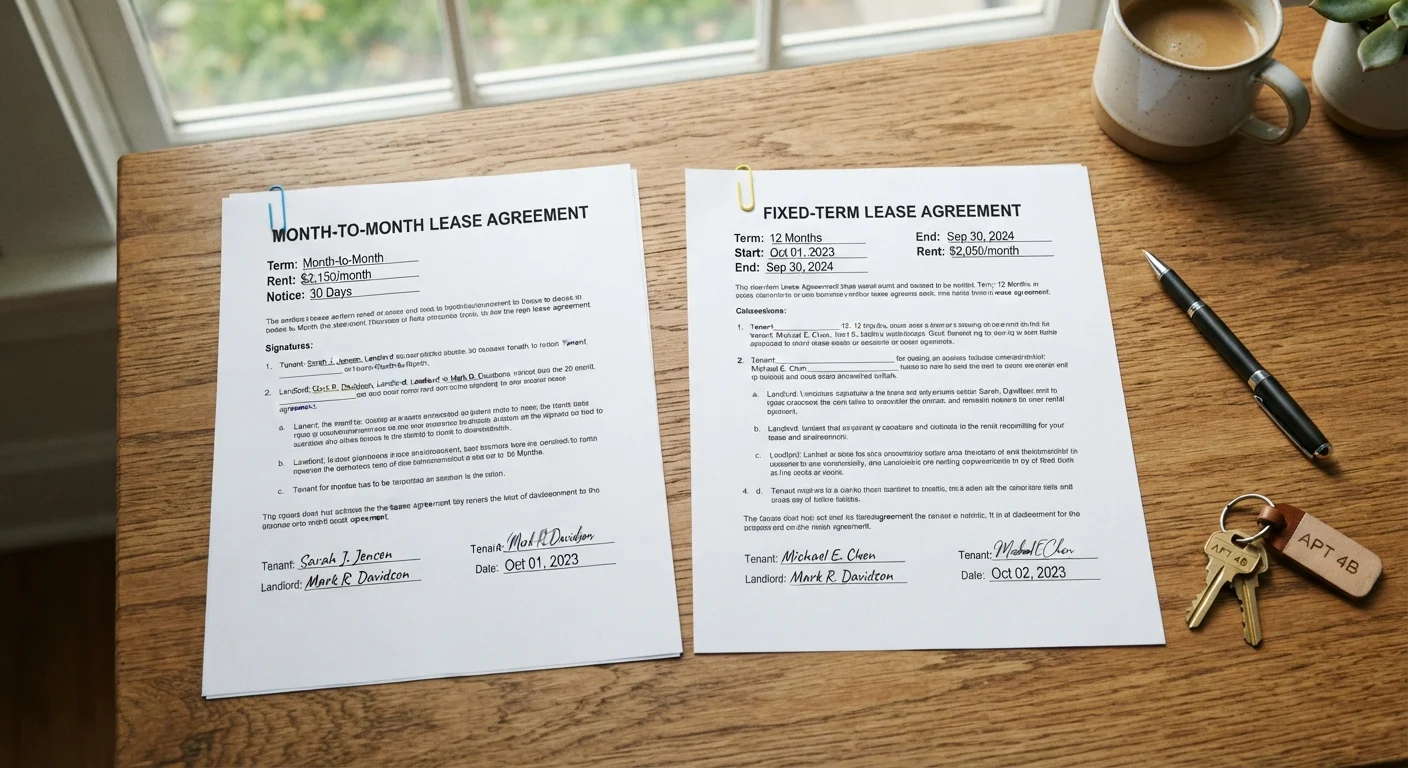
Photo credit: ProximityFinds.com | One-stop Reading Source
In this article
Month-to-month and fixed-term leases each come with trade-offs in flexibility, stability, and legal obligations. Here's how they compare.
Key Takeaways
- Month-to-month leases offer flexibility but allow either party to end the arrangement with relatively short notice.
- Fixed-term leases lock in rent and occupancy for a set period, providing stability but limiting exit options.
- Landlords can generally raise rent more easily under a month-to-month arrangement, subject to applicable state and local laws.
- Breaking a fixed-term lease early typically carries financial penalties for tenants.
- State law governs required notice periods and tenant protections regardless of which lease type is used.
- Neither lease type is universally better - the right choice depends on each party's priorities and circumstances.
How Each Lease Type Works
A fixed-term lease is a binding contract for a defined period - most commonly 12 months, though six-month and two-year terms exist. During that time, the rent amount, occupancy rights, and core conditions are locked in. Neither party can unilaterally change material terms or end the arrangement early without legal or financial consequences.
A month-to-month lease (also called a periodic tenancy) renews automatically each month unless one party provides written notice to end it. This arrangement may begin that way from the start, or a fixed-term lease may convert to month-to-month automatically after its expiration if neither party takes action to renew or vacate.
Both lease types are legally binding contracts. The difference lies not in enforceability but in duration, flexibility, and the rules governing changes and termination. To understand what your lease actually commits you to, see what key lease clauses mean before signing either type.
| Criterion | Month-to-Month Lease | Fixed-Term Lease |
|---|---|---|
| Duration | Renews automatically each month | Set period (typically 6-24 months) |
| Rent stability | Can change with proper notice | Locked in for the term |
| Tenant exit flexibility | High - typically 30-60 days notice | Low - early exit carries penalties |
| Landlord flexibility | High - can end tenancy with notice | Low - must honor full term absent just cause |
| Vacancy risk (landlord) | Higher - tenant can leave each month | Lower - occupancy is guaranteed |
| Typical rent premium | Often higher for flexibility | Often lower for commitment |
| Notice to terminate | 30-60 days (varies by state) | Governed by lease end date |
| Best for renters | Uncertain or short-term plans | Stable, long-term housing needs |
| Best for landlords | Properties with anticipated changes | Stable, income-focused rental strategy |
Flexibility and Stability: The Core Trade-Off
The central distinction is the tension between flexibility and stability - and both parties sit on opposite sides of the same trade-off.
For tenants, a fixed-term lease provides protection: rent cannot increase mid-term, and a landlord cannot ask them to vacate without cause before the term ends (in most states). A month-to-month arrangement, by contrast, exposes renters to rent increases or a notice to vacate at the end of virtually any given month, subject to state-mandated notice requirements - often 30 to 60 days.
For landlords, fixed-term leases reduce vacancy risk and create income certainty. Month-to-month agreements give operational flexibility: if the landlord wants to sell the property, move in a family member, or significantly renovate, they can end the tenancy with proper notice rather than waiting out a lease term.
Rent adjustments are another key variable. Under a month-to-month lease, landlords can raise rent at the start of any new period - provided they give legally required advance notice. Under a fixed-term lease, rent is generally locked for the duration unless the lease includes an explicit escalation clause. For a closer look at how rent increases work legally, see what landlords can and can't do when raising rent.
30-60 days
Typical notice required to end month-to-month tenancy
Most US states mandate a minimum of 30 days written notice; some require 60 days for tenants who have rented for a year or more.
12 months
Most common fixed-term lease length in the US
One-year leases are the standard in most US residential rental markets, though terms vary by region and property type.
1-2 months
Typical early termination fee under fixed-term leases
Early termination clauses commonly require tenants to pay one to two months' rent as a penalty, though terms vary by lease and jurisdiction.
Early Termination and Notice Requirements
Exiting a lease before its natural end is where the practical differences become most consequential.
With a month-to-month lease, either party can end the arrangement by giving proper written notice - typically 30 days, though some states require 60 days or more, particularly for longer-tenured renters. This notice period is set by state law, not just the lease agreement, and landlords and tenants should verify their state's requirements.
Breaking a fixed-term lease early is far more consequential for tenants. Common consequences include forfeiting part or all of the security deposit, being held liable for remaining rent until a replacement tenant is found, or paying a specified early termination fee outlined in the lease. Some states require landlords to make reasonable efforts to re-rent the unit (a duty to mitigate damages) rather than collecting the full remaining balance from the departing tenant.
Landlords also face constraints under a fixed-term lease. They generally cannot terminate the tenancy before the term ends without just cause - such as nonpayment of rent, lease violations, or other legally recognized grounds - depending on state law.
State Law Governs Notice and Protections
Lease termination rules, required notice periods, and tenant protections vary considerably by state - and in some cities, by local ordinance as well. For example, California requires 60 days notice for tenants who have rented for more than a year, while many other states default to 30 days. Rent control or just-cause eviction laws in certain jurisdictions also apply regardless of what lease type is in use. Always verify the rules that apply in your specific location.
Which Structure Makes Sense for Your Situation
The right lease type depends on each party's goals, risk tolerance, and time horizon - not a universal rule. A few practical considerations:
- Renters planning a long-term stay typically benefit from fixed-term leases, which lock in rent and provide security against sudden displacement.
- Renters in transition - navigating a job search, a recent move to a new city, or an uncertain personal situation - often find month-to-month arrangements worth the higher rent that landlords sometimes charge for the added flexibility.
- Landlords in stable rental markets with low vacancy rates often favor fixed-term leases to reduce turnover costs and maintain consistent occupancy.
- Landlords anticipating property changes - a planned sale, renovation, or owner-occupancy - may prefer month-to-month so they can regain possession without navigating early termination rules.
It's worth noting that some leases include automatic renewal clauses that convert a fixed-term agreement to month-to-month unless proper written notice is given. Both parties should review this provision carefully. For more on common misunderstandings that affect both tenants and landlords, see widely believed renting myths that often turn out to be wrong.
If you're still weighing whether to rent at all, the real trade-offs between renting and buying covers that broader decision in depth.
This article provides general information about lease types for educational purposes only and does not constitute legal advice. Lease laws vary significantly by state and locality. Consult a qualified real estate attorney or local tenant rights organization for guidance specific to your situation.

Author
Real Estate Editorial Team
Real Estate Editorial Team is the collective byline for our editorial team and contributor network. Articles published under this byline or an editorial pen name are researched, written, and reviewed according to our editorial standards for clarity, consistency, and independence before publication.
View all articles →