
Renting vs. Buying: How to Think Through the Decision Honestly
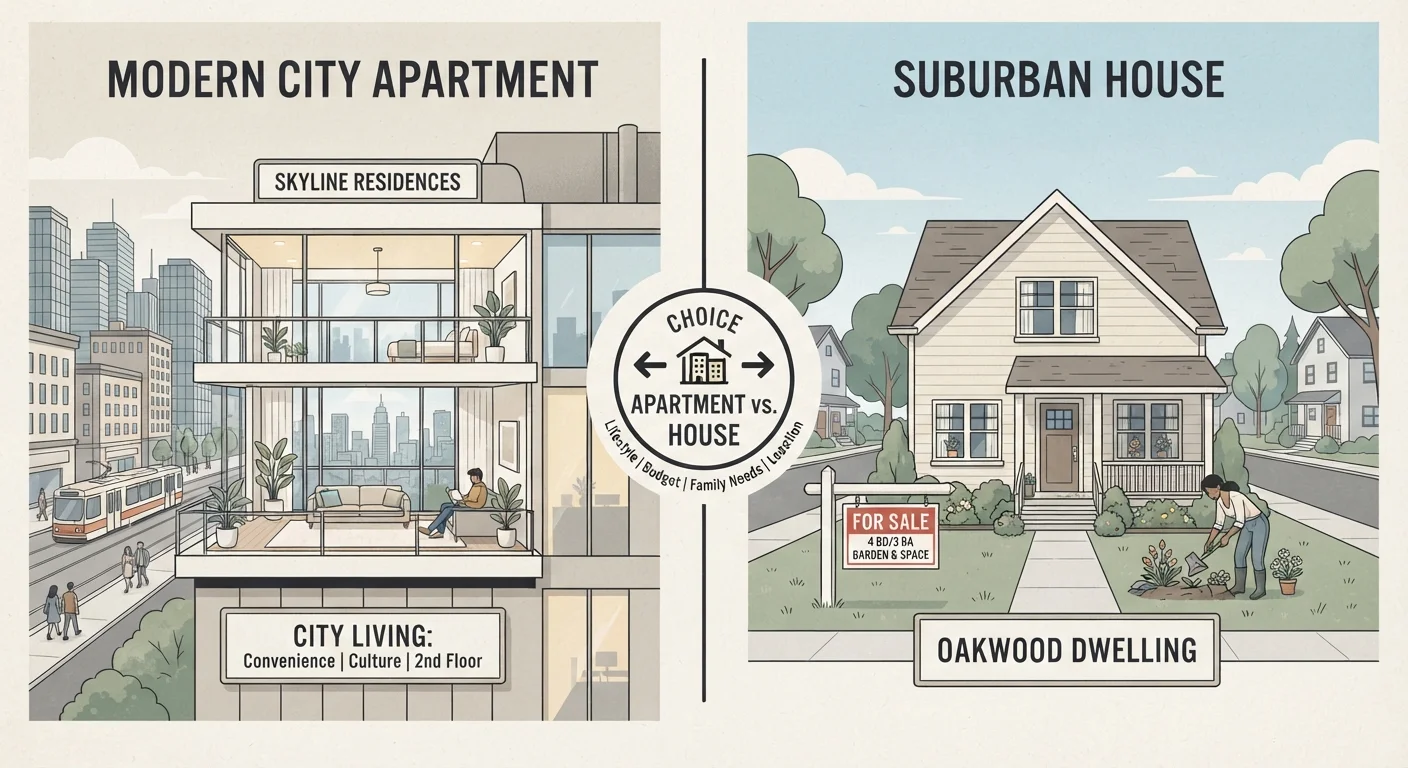
Photo credit: ProximityFinds.com | One-stop Reading Source
In this article
The rent-vs.-buy decision depends on your finances, timeline, and local market — not just a simple calculation. Here's how to weigh it.
Key Takeaways
- Buying builds equity over time but requires substantial upfront capital and long-term commitment.
- Renting offers flexibility and lower immediate costs, but provides no ownership stake.
- Your local housing market, income stability, and expected time horizon are critical factors.
- The true cost of homeownership extends well beyond the mortgage payment.
- Neither renting nor buying is universally superior - context determines the right call.
Builds equity and long-term net worth
Each mortgage payment reduces your principal balance, gradually converting housing costs into an asset. Over many years, this can represent a meaningful portion of a household's total wealth.
Protection from rent increases
A fixed-rate mortgage locks in your principal and interest payment for the loan term, shielding you from the market rent volatility that renters face at each lease renewal.
Freedom to modify and personalize
Owners can renovate, paint, landscape, and alter the property without landlord approval, giving full control over the living environment and the ability to increase value through improvements.
Potential tax benefits
Mortgage interest and property taxes may be deductible for itemizing taxpayers under current U.S. tax law, though the benefit depends on individual tax situations and should be verified with a tax professional.
Stability and community roots
Ownership typically means longer tenure in one location, which supports deeper community ties, school continuity for children, and a more stable personal environment.
Renting preserves financial flexibility
Down payments and closing costs - often tens of thousands of dollars - remain liquid when renting, available for investment, emergencies, or other priorities rather than being locked into a single illiquid asset.
Maintenance and repairs are not your burden
When a furnace fails or a roof leaks, a landlord is responsible for the cost and coordination. Renters avoid the financial unpredictability of homeownership's maintenance obligations.
Easier to relocate for opportunity
Renters can move with relatively little friction at lease end - a major advantage for people in early career stages or fields where geographic mobility improves earning potential.
No exposure to property value declines
Home values can fall as well as rise. Renters are insulated from market downturns that can leave owners underwater on their mortgage or unable to sell without a loss.
Lower upfront financial requirements
Renting typically requires only a security deposit and first month's rent, making it accessible to those who have not yet accumulated a substantial down payment or emergency fund.
Why This Decision Is Harder Than It Looks
The rent-vs.-buy debate is often framed as a simple financial calculation, but the reality is messier. Monthly mortgage payments can look competitive with rent in some cities and wildly unaffordable in others. Cultural narratives - "renting is throwing money away" or "homeownership is the American Dream" - cloud what should be a practical, numbers-driven assessment.
The most useful starting point is honest self-inventory: How long do you plan to stay in this area? How stable is your income? How much liquid savings do you have? Do you value flexibility or stability more right now? These questions matter as much as any mortgage rate comparison. For a broader overview of the trade-offs involved, see our article on renting vs. buying a home.
"Renting Is Throwing Money Away" - A Common Misconception
This phrase is one of the most persistent myths in personal finance. Rent buys you housing, flexibility, and freedom from maintenance risk - none of which is wasted value. Meanwhile, homeowners also "throw away" money on mortgage interest, property taxes, and maintenance costs that build no equity. The comparison is always more nuanced than the slogan suggests. For a deeper look at widely held misconceptions in the rental space, see our piece on common myths about renting.
The Case for Buying: Real Advantages
Homeownership offers tangible financial and personal benefits that renting cannot replicate. Understanding these honestly - without overselling them - helps clarify when buying makes sense.
Builds equity and long-term net worth
Each mortgage payment reduces your principal balance, gradually converting housing costs into an asset. Over many years, this can represent a meaningful portion of a household's total wealth.
Protection from rent increases
A fixed-rate mortgage locks in your principal and interest payment for the loan term, shielding you from the market rent volatility that renters face at each lease renewal.
Freedom to modify and personalize
Owners can renovate, paint, landscape, and alter the property without landlord approval, giving full control over the living environment and the ability to increase value through improvements.
Potential tax benefits
Mortgage interest and property taxes may be deductible for itemizing taxpayers under current U.S. tax law, though the benefit depends on individual tax situations and should be verified with a tax professional.
Stability and community roots
Ownership typically means longer tenure in one location, which supports deeper community ties, school continuity for children, and a more stable personal environment.
One underappreciated factor is forced savings: each mortgage payment that reduces principal is money you are keeping, not spending. Over a decade or more, that accumulation can represent significant personal wealth. However, this only holds if you stay long enough to offset the substantial transaction costs of buying and selling. If you decide to move forward, our guide on the home-buying process, start to finish walks through every stage.
The Case for Renting: Legitimate Strengths
Renting is frequently dismissed, but for many people at many life stages it is genuinely the more rational financial choice. The key is recognizing when that applies to you.
Renting preserves financial flexibility
Down payments and closing costs - often tens of thousands of dollars - remain liquid when renting, available for investment, emergencies, or other priorities rather than being locked into a single illiquid asset.
Maintenance and repairs are not your burden
When a furnace fails or a roof leaks, a landlord is responsible for the cost and coordination. Renters avoid the financial unpredictability of homeownership's maintenance obligations.
Easier to relocate for opportunity
Renters can move with relatively little friction at lease end - a major advantage for people in early career stages or fields where geographic mobility improves earning potential.
No exposure to property value declines
Home values can fall as well as rise. Renters are insulated from market downturns that can leave owners underwater on their mortgage or unable to sell without a loss.
Lower upfront financial requirements
Renting typically requires only a security deposit and first month's rent, making it accessible to those who have not yet accumulated a substantial down payment or emergency fund.
Renters also preserve optionality. If your job changes, your family grows, or a better opportunity appears in another city, you are not anchored to a property. For those who value or need that flexibility, the premium is worth paying. Renters navigating their lease structure can also benefit from understanding month-to-month vs. fixed-term leases to match their arrangement to their circumstances.
The Numbers That Actually Matter
Any honest comparison must account for the full cost of ownership, not just the mortgage. Buyers typically spend 1-3% of a home's value annually on maintenance and repairs - a figure that compounds significantly on higher-priced properties. Add property taxes, homeowner's insurance, HOA fees where applicable, and the opportunity cost of a down payment that is no longer invested.
6-8%
Typical total transaction cost to buy and sell
Industry estimates suggest buyers and sellers together absorb roughly 6-8% of a home's price in agent commissions, closing costs, and related fees across a complete transaction cycle.
1-3%
Annual home maintenance cost as % of value
A commonly cited rule of thumb in personal finance and real estate education holds that homeowners should budget 1-3% of their property's value each year for maintenance and repairs.
5+ years
Minimum horizon often needed to break even
Many financial planning frameworks suggest a minimum five-year ownership period before transaction costs are typically recouped through equity growth and avoided rent increases.
On the renting side, the relevant number is your monthly payment relative to what you would spend on a comparable owned home - not just the mortgage, but the total carrying cost. In high-cost markets, the gap between renting and owning the same type of unit can be thousands of dollars per month. In more affordable markets, the math frequently favors buying within a few years. Run both scenarios with real local data before deciding.
How Your Timeline Changes Everything
Perhaps the single most decisive variable is how long you plan to stay. Transaction costs - agent commissions, closing costs, title fees - typically run 8-10% of a home's value across a complete buy-sell cycle. A home generally needs to appreciate enough to cover those costs before an owner breaks even.
Most financial planners suggest a minimum five-year horizon before buying makes consistent mathematical sense, though this threshold varies by market and appreciation rate. If there is meaningful uncertainty about where you will be living in three years, that uncertainty has real dollar value - and renting preserves it. For more context on the renter's landscape, explore the Renting & Landlords hub for practical guidance on leases, rights, and responsibilities.
This article is for general informational and educational purposes only and does not constitute financial, legal, or investment advice. Consult a qualified financial adviser or real estate professional before making decisions based on your individual circumstances.

Author
Real Estate Editorial Team
Real Estate Editorial Team is the collective byline for our editorial team and contributor network. Articles published under this byline or an editorial pen name are researched, written, and reviewed according to our editorial standards for clarity, consistency, and independence before publication.
View all articles →