
Tire Markings Decoded: Reading the Numbers on Your Sidewall
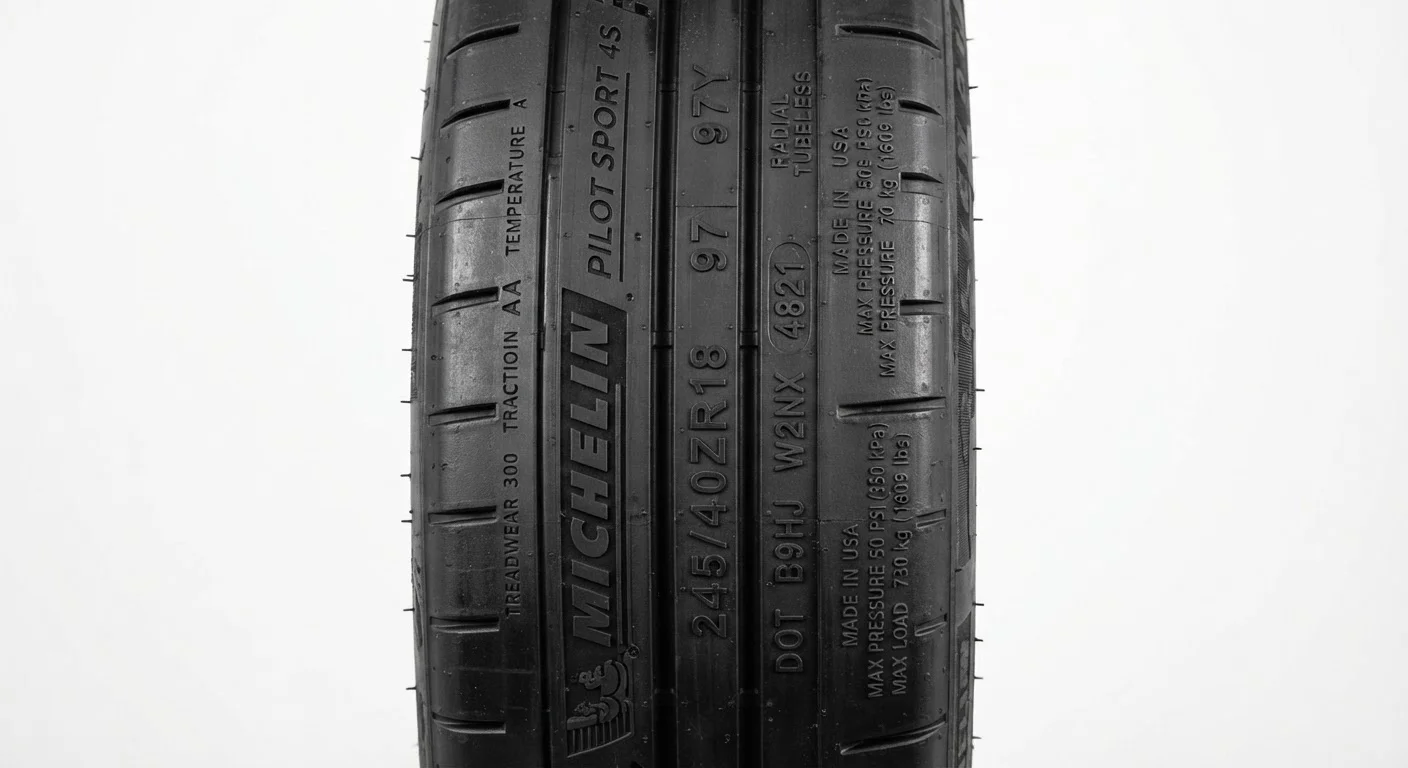
Photo credit: ProximityFinds.com | One-stop Reading Source
In this article
That string of numbers and letters on your tire tells you width, aspect ratio, load rating, and speed rating. Here's how to read them.
Breaking Down the Full Tire Code
Pick any tire and you'll find a string like P215/65R16 98H molded into the sidewall. It looks like a serial number, but every character carries a specific meaning. Here's how each piece breaks down.
Type prefix (P, LT, ST, T): The first letter or letters identify the tire's intended use. P stands for Passenger vehicle. LT means Light Truck - these tires are built for higher load demands. ST denotes Special Trailer use, and T indicates a temporary spare. Some European-spec tires skip this prefix entirely.
Section width (215): The three-digit number that follows is the tire's width in millimeters, measured across the widest point of the inflated tire from sidewall to sidewall.
Aspect ratio (65): After the slash comes the aspect ratio - the sidewall height as a percentage of the section width. A 65 means the sidewall height is 65% of 215 mm. Lower numbers (40, 45) signal a low-profile tire with a shorter, stiffer sidewall.
Construction type (R): The letter R stands for Radial, which is the standard construction for virtually all modern passenger tires. You may occasionally see B (Bias-ply) on older or specialty tires.
Rim diameter (16): The final number before the load and speed codes is the wheel diameter in inches. This must match your wheel exactly - a 16-inch tire will not seat on a 17-inch rim.
| Tire width unit | Millimeters (mm) |
| Rim diameter unit | Inches |
| Most common tire type prefix | P (Passenger) |
| Load index range (passenger cars) | Typically 75-100 (Tire and Rim Association standard tables) |
| Speed rating H corresponds to | 130 mph (210 km/h) |
| UTQG treadwear baseline | 100 (reference course standard) (U.S. DOT / NHTSA) |
Load Index and Speed Rating Explained
The numbers and letter after the rim diameter - 98H in our example - cover how much the tire can carry and how fast it's rated to go.
Load index (98): This two- or three-digit number maps to a specific maximum load capacity per tire. A load index of 98 corresponds to 1,653 lbs. per tire. When replacing tires, always match or exceed the load index your vehicle manufacturer specifies - going lower puts your vehicle over the tire's rated capacity.
Speed rating (H): The trailing letter indicates the maximum sustained speed the tire is engineered to handle. Common ratings you'll see on passenger vehicles include S (112 mph), T (118 mph), H (130 mph), V (149 mph), and W (168 mph). The speed rating reflects not just raw speed but the tire's ability to manage heat buildup at that speed - a critical safety consideration. Like the load index, never substitute a lower speed rating than your vehicle requires.
Your Vehicle's Placard Overrides Everything
The correct tire size and inflation pressure for your car are printed on a placard inside the driver's door jamb - not on the tire itself. Always reference that placard when replacing tires. Tires are sometimes upsized from the factory specification for aesthetics, so confirm with a qualified tire professional if you're unsure whether a size change is appropriate for your vehicle.
Once you understand these codes, it's also worth knowing that your tires communicate in real time through your TPMS sensor. If the low-pressure warning light comes on, the dashboard warning lights guide explains what that - and other symbols - actually mean.
Additional Markings Worth Knowing
Beyond the main size and rating code, tires carry several other markings that provide useful information.
Aspect Ratio
The ratio of the tire's sidewall height to its width, expressed as a percentage. A lower number means a shorter sidewall and typically a wider, flatter tire.
Load Index
A numerical code indicating the maximum weight a single tire can safely support when properly inflated. You must match or exceed your vehicle's required load index.
Speed Rating
A letter code indicating the maximum sustained speed a tire is designed to handle. It reflects the tire's construction and heat tolerance at speed.
Section Width
The measurement in millimeters across the widest point of the tire, from sidewall to sidewall, when mounted and inflated but carrying no load.
Rim Diameter
The diameter of the wheel the tire is designed to fit, measured in inches. This must match your wheel exactly.
UTQG Rating
Uniform Tire Quality Grading - a U.S. government-mandated rating system covering treadwear, traction, and temperature resistance, allowing comparison across tire lines.
DOT code: A string beginning with DOT includes a four-digit date code at the end - the week and year of manufacture. The last four digits tell you when the tire was made (e.g., 2322 = 23rd week of 2022). Age matters: most manufacturers and safety organizations suggest replacing tires after six to ten years regardless of tread depth, because rubber degrades over time.
UTQG ratings: You'll see three numbers and a letter near the DOT area, such as 500 A A. The first number is the treadwear grade (higher means longer-lasting tread relative to a government test baseline). The second character is traction grade (AA, A, B, or C) - how well the tire stops on wet pavement. The third is temperature grade (A, B, or C) - the tire's heat resistance at speed.
Rotation direction and inside/outside markings: Some performance and asymmetric tires have arrows indicating which direction the tire must rotate, or markings for which side faces outward. These are not optional - mounting them incorrectly affects handling and wear.
Understanding these codes makes conversations with a tire shop far less intimidating. And once you know your tire size, keeping those tires properly inflated is the next piece of the puzzle. See how pressure affects wear, fuel economy, and safety in our article on tire pressure and what getting it wrong costs you.
~11%
U.S. vehicles with at least one significantly underinflated tire
According to NHTSA data, a significant share of vehicles on U.S. roads have tires not inflated to the vehicle manufacturer's specification.
70+
Load index values available in standard tire tables
The Tire and Rim Association publishes standardized load index tables with over 70 values, translating index numbers to exact pound and kilogram ratings.

Author
Automotive Editorial Team
Automotive Editorial Team is the collective byline for our editorial team and contributor network. Articles published under this byline or an editorial pen name are researched, written, and reviewed according to our editorial standards for clarity, consistency, and independence before publication.
View all articles →