
How a Four-Stroke Engine Turns Gasoline Into Motion
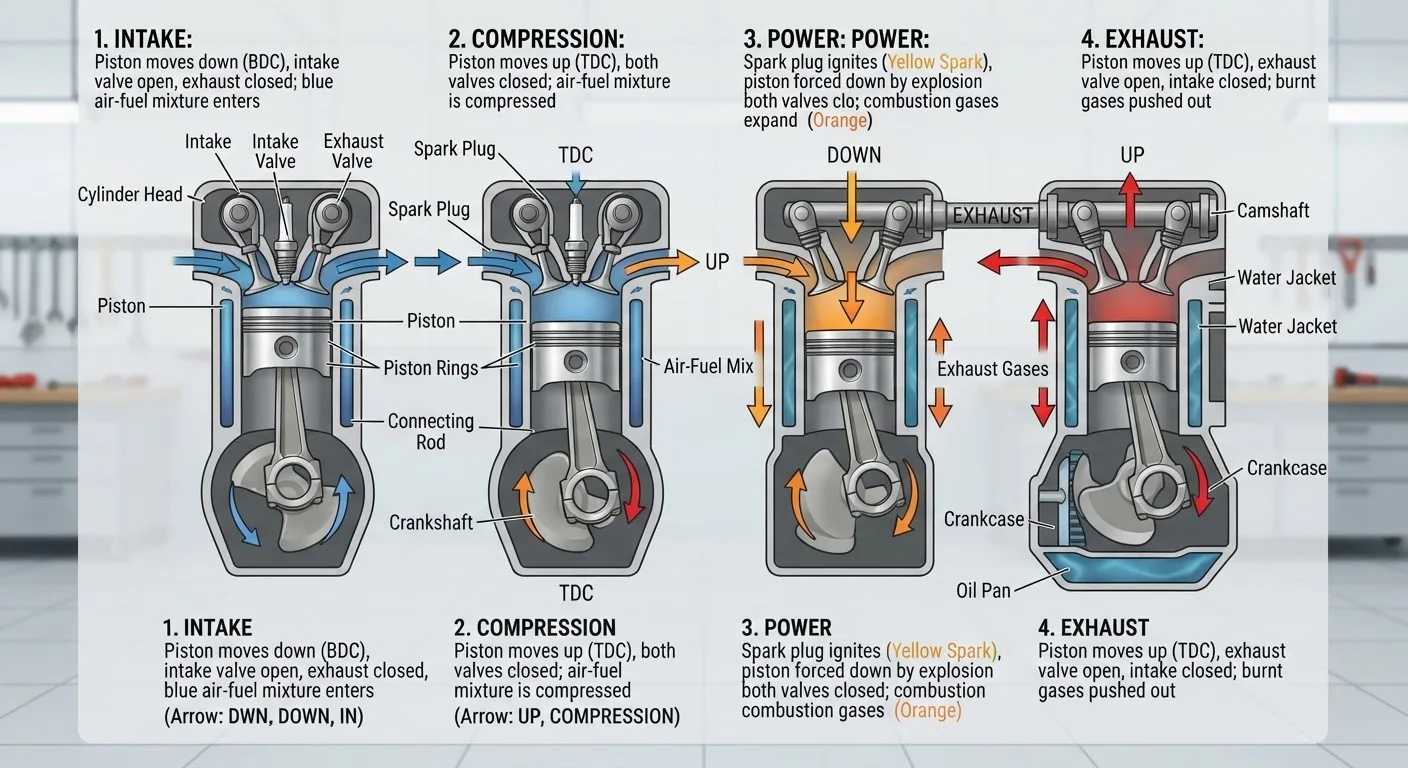
Photo credit: ProximityFinds.com | One-stop Reading Source
In this article
A plain-English walkthrough of the intake, compression, combustion, and exhaust strokes that power every gas-engine car.
Key Takeaways
- Every gasoline car engine uses the same four-stroke cycle: intake, compression, combustion, and exhaust.
- The combustion stroke is the only one that actually produces power - the other three are setup and cleanup.
- Multi-cylinder engines fire these strokes in a staggered sequence to deliver smooth, continuous power.
- Understanding this cycle helps you make sense of concepts like displacement, compression ratio, and engine maintenance.
- Modern fuel injection systems precisely control the air-fuel mix that enters on the intake stroke.
Stroke 1: Intake - Pulling in the Mix
The cycle begins when the piston sits near the top of the cylinder and starts moving downward. As it descends, it creates a low-pressure zone - essentially a vacuum - inside the cylinder. The intake valve opens to take advantage of this, allowing a mixture of air and fuel to rush in and fill the space.
How that fuel gets mixed with air before entering the cylinder is a story in itself. Modern fuel injection systems have largely replaced older carburetors for this job, delivering a precisely metered spray of fuel directly into the intake air. Once the piston reaches the bottom of its travel and the cylinder is full, the intake valve closes - trapping the air-fuel charge inside.
Stroke 2: Compression - Squeezing for More Power
With both the intake and exhaust valves now closed, the piston reverses and travels back up the cylinder. This compresses the air-fuel mixture into a much smaller space at the top of the cylinder, known as the combustion chamber.
Compression matters because a compressed gas releases more energy when ignited than an uncompressed one. The ratio of the cylinder's total volume to that small combustion chamber volume is called the compression ratio. Most regular gasoline engines run compression ratios between 9:1 and 12:1. Higher-compression engines extract more energy from each drop of fuel but require higher-octane gasoline to prevent the mixture from igniting too early - a knock you might have heard on a poorly fueled engine.
9:1-12:1
Typical compression ratio in a gasoline engine
Higher ratios improve thermal efficiency but demand higher-octane fuel to prevent pre-ignition knock.
~30%
Thermal efficiency of a typical gasoline engine
According to the U.S. Department of Energy, only about 30% of the energy in gasoline is converted to motion in a conventional engine.
4
Strokes per complete engine cycle
The intake, compression, combustion, and exhaust strokes together require two full crankshaft rotations to complete.
Stroke 3: Combustion - The Power Stroke
Just as the piston reaches the top of its compression stroke, the spark plug fires an electrical spark into the compressed air-fuel mixture. The fuel ignites and burns rapidly - not an explosion in the dramatic sense, but a fast, controlled burn that expands the gases with tremendous force.
That expanding gas pushes the piston forcefully back down the cylinder. This downward push is the only stroke of the four that actually generates power. The piston's linear motion connects via a connecting rod to the crankshaft, which converts that up-and-down movement into the rotational force - called torque - that eventually reaches your wheels.
“The internal combustion engine is, at its core, an air pump. Everything else - fuel delivery, ignition timing, exhaust flow - is in service of moving air through that cycle as efficiently as possible.”
— Automotive Engineering Educators, Consensus view among engine design instructors in automotive technology programs
Stroke 4: Exhaust - Clearing the Chamber
After the power stroke, the cylinder contains spent combustion gases - carbon dioxide, water vapor, and other byproducts. These need to exit before a fresh charge can enter. The exhaust valve opens and the piston travels back up, pushing the waste gases out through the exhaust port and eventually out your tailpipe.
Once the piston reaches the top again, the exhaust valve closes, the intake valve reopens, and the whole cycle begins again instantly. In a four-cylinder engine, this sequence runs in all four cylinders simultaneously but timed so their power strokes are evenly spaced - one cylinder fires every half-rotation of the crankshaft, keeping power delivery smooth.
If you want to understand what happens when engineers force even more air into these cylinders to amplify power output, see our explainer on turbochargers and superchargers.
Maintenance Connects Directly to the Cycle
Every scheduled maintenance item on a gasoline engine ties back to one of the four strokes. Fresh spark plugs ensure a reliable ignition event on the combustion stroke. A clean air filter supports proper airflow on the intake stroke. Keeping up with these services isn't just routine - it's keeping each stroke working as it should.
Why This Matters for Everyday Drivers
You don't need to be a mechanic to benefit from understanding the four-stroke cycle. Knowing that the intake stroke draws in air and fuel helps explain why a clogged air filter hurts performance and fuel economy - the engine simply can't breathe properly. Understanding compression explains why using the right octane fuel matters. And recognizing that exhaust gases must exit cleanly puts the importance of a functioning catalytic converter and exhaust system in plain context.
Every tune-up item - spark plugs, air filters, fuel injectors - connects directly to one of these four strokes. When a mechanic explains a repair, knowing the cycle gives you the context to ask the right questions and make confident decisions about your vehicle.
Frequently Asked Questions

Author
Automotive Editorial Team
Automotive Editorial Team is the collective byline for our editorial team and contributor network. Articles published under this byline or an editorial pen name are researched, written, and reviewed according to our editorial standards for clarity, consistency, and independence before publication.
View all articles →