
Fuel Injection vs. Carburetors: The Technology Behind Mixing Air and Fuel
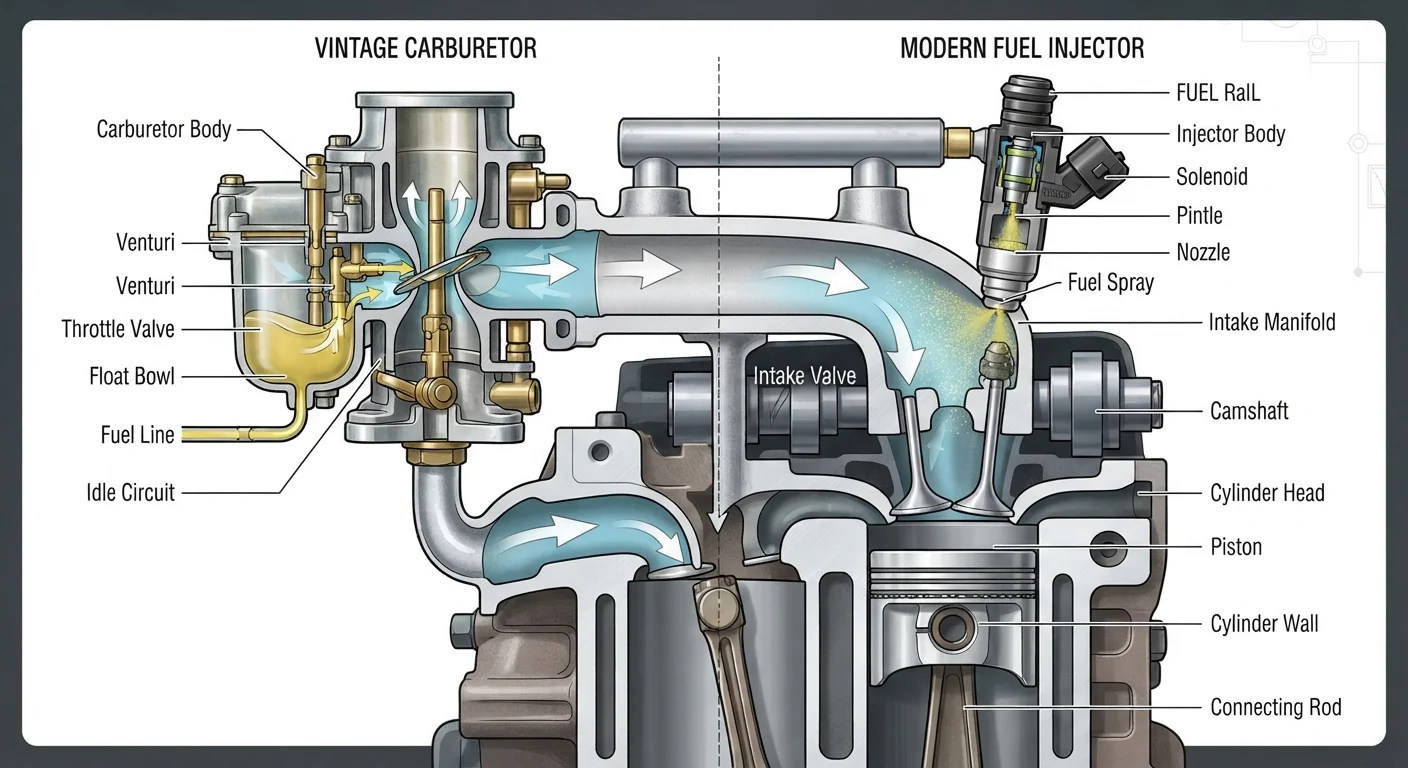
Photo credit: ProximityFinds.com | One-stop Reading Source
Trace the shift from carburetors to modern fuel injection and learn why the change improved efficiency, emissions, and cold starts.
Key Takeaways
- Carburetors mix air and fuel mechanically using vacuum pressure; fuel injection uses electronically controlled injectors.
- Fuel injection delivers better fuel economy, cleaner emissions, and more reliable starts in cold weather.
- Carburetors are simpler to repair by hand but less precise under varying conditions.
- Most vehicles made after the mid-1990s use fuel injection as standard equipment.
- Understanding the difference helps drivers make sense of maintenance needs and engine behavior.
How a Carburetor Works
A carburetor is a purely mechanical device that mixes air and gasoline before the mixture enters the engine's cylinders. It operates on a straightforward principle called the Venturi effect: as air rushes through a narrow passage in the carburetor throat, it speeds up and creates a low-pressure zone. That pressure drop draws fuel up from a small reservoir called a float bowl, atomizing it into the incoming airstream.
The driver controls airflow - and therefore power - through the throttle plate, which is connected directly to the accelerator pedal. Richer or leaner fuel mixtures are achieved by adjusting needle valves and jet sizes, typically set once during a tune-up rather than continuously recalibrated.
The main limitation is that this mechanical process can't react instantly to changing conditions. Cold mornings, high altitudes, and rapid acceleration all shift the ideal air-to-fuel ratio, and a carburetor has no electronic sensor to compensate. That's where a manual choke - or an automatic choke on later models - came in, temporarily enriching the mixture for cold starts. Getting it wrong often meant a flooded engine or rough idle.
| Criterion | Carburetor | Fuel Injection |
|---|---|---|
| Fuel metering method | Mechanical vacuum-driven | Electronic, sensor-controlled |
| Cold-start reliability | Requires choke adjustment | Fully automatic adjustment |
| Fuel efficiency | Lower; often runs rich | Higher; near-ideal ratio |
| Emissions output | Higher hydrocarbons and CO | Significantly lower |
| High-altitude performance | Degrades without manual rejet | Adapts automatically |
| Repairability | Simple; basic tools suffice | Requires diagnostic equipment |
| Era of common use | Pre-1990s vehicles | Standard from mid-1990s onward |
How Fuel Injection Works
Fuel injection replaces the carburetor's passive mixing with an active, computer-managed system. A component called the Engine Control Unit (ECU) - essentially the engine's onboard computer - collects data from multiple sensors monitoring oxygen levels in the exhaust, engine temperature, air intake volume, throttle position, and more. Using that data, it calculates the precise amount of fuel needed at any given moment and signals injectors to spray a fine mist directly into the intake port or, in direct injection systems, straight into the combustion chamber.
This happens in milliseconds, hundreds of times per second. The result is a fuel mixture that's almost always closer to the ideal ratio (roughly 14.7 parts air to 1 part fuel by mass, called the stoichiometric ratio), regardless of weather, altitude, or driving demand.
Modern fuel injection systems also communicate with emissions controls like the catalytic converter, helping ensure cleaner exhaust output. If you've ever wondered how today's turbocharged engines manage power and efficiency simultaneously, fuel injection is a big part of the answer - see our guide to turbochargers and superchargers for how forced induction pairs with fuel management.
~15%
Typical fuel economy improvement with fuel injection
Engineering analyses of the carburetor-to-injection transition commonly cite fuel economy gains in the range of 10-20% depending on engine and driving conditions.
1996
Year all new US cars required OBD-II and fuel injection compatibility
The US Environmental Protection Agency's OBD-II mandate, taking full effect for model year 1996, effectively standardized fuel injection across new passenger vehicles sold in America.
Key Differences That Matter to Drivers
The practical gap between carburetors and fuel injection shows up in everyday driving situations that most people recognize, even without knowing the cause.
Cold starts: A carbureted engine often needs a warm-up period and careful choke operation on cold mornings. Fuel injection handles this automatically - you turn the key and drive. Fuel economy: Because injection continuously optimizes the mixture, less fuel is wasted. Carburetors tend to run slightly rich (too much fuel) in many conditions, which hurts efficiency. Emissions: Fuel injection made it far easier for automakers to meet tightening Clean Air Act standards beginning in the 1970s and accelerating through the 1980s and 1990s. High-altitude performance: Carburetors don't automatically adjust for thinner air at elevation; fuel injection does.
The tradeoff is complexity. A carburetor can often be rebuilt with a wrench and an afternoon. Diagnosing a fuel injection fault typically requires a scan tool to read ECU error codes, and injector replacement involves both parts and labor costs. For everyday modern drivers, the performance and reliability benefits far outweigh the added complexity. For classic vehicle owners, the carburetor's repairability is a genuine advantage.
Throttle Body vs. Port vs. Direct Injection
Fuel injection isn't a single system - it comes in several forms. Throttle body injection (TBI) places one or two injectors at the throttle, similar in location to a carburetor. Multi-port injection (MPI) puts an injector at each cylinder's intake port. Gasoline direct injection (GDI) sprays fuel directly into the combustion chamber for maximum precision. Each generation improved efficiency and emissions further, which is why newer engines often outperform older injected designs even on paper.

Author
Automotive Editorial Team
Automotive Editorial Team is the collective byline for our editorial team and contributor network. Articles published under this byline or an editorial pen name are researched, written, and reviewed according to our editorial standards for clarity, consistency, and independence before publication.
View all articles →