
Roundabouts vs. Traditional Intersections: Which Is Actually Safer?
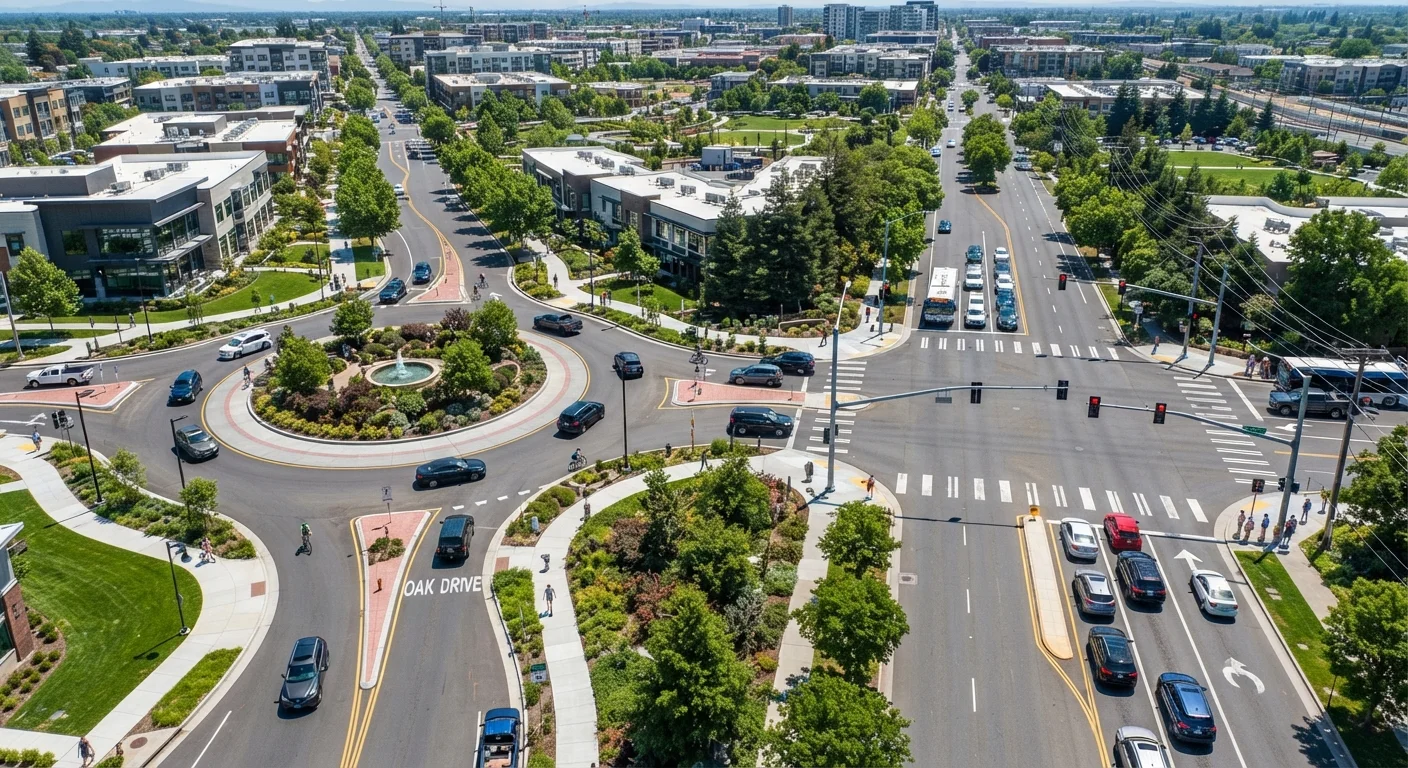
Photo credit: ProximityFinds.com | One-stop Reading Source
In this article
Research consistently favors roundabouts for reducing serious crashes—but only when drivers know how to use them. Here's what the data shows.
Key Takeaways
- Roundabouts significantly reduce fatal and injury-causing crashes compared to traditional signalized intersections.
- The lower speeds in roundabouts are the primary reason crash severity drops so dramatically.
- Traditional intersections still handle certain high-volume or complex traffic patterns more effectively.
- Driver unfamiliarity with roundabouts temporarily increases minor fender-benders when they are first installed.
- Pedestrian and cyclist safety at roundabouts depends heavily on good design and driver awareness.
What Makes These Two Intersection Types Different
A roundabout is a circular intersection where traffic flows in one direction around a central island. Drivers yield to circulating traffic before entering, then exit at their desired street. There are no traffic lights, no left turns across oncoming lanes, and no stopping except to yield.
A traditional intersection - whether controlled by a stop sign or a traffic signal - brings vehicles through perpendicular paths. Left turns cross opposing traffic. Red lights create full stops. Right-of-way is determined either by signal phase or posted rules.
That structural difference matters enormously for safety. The number of conflict points - spots where two vehicles can collide - drops from 32 at a standard four-way signalized intersection to just 8 at a single-lane roundabout. Fewer conflict points, and lower entry speeds, translate directly into fewer and less severe crashes.
Four-way stops are a separate category worth understanding on their own - the right-of-way rules trip up even experienced drivers.
What the Safety Data Actually Shows
The Federal Highway Administration (FHWA) has reviewed dozens of before-and-after studies at U.S. intersections converted from traditional designs to roundabouts. The findings are consistent: roundabouts reduce fatal crashes by roughly 90% and injury crashes by around 75% at those locations.
~90%
Reduction in fatal crashes at roundabouts
According to Federal Highway Administration before-and-after studies at U.S. intersections converted to roundabouts.
8 vs. 32
Vehicle conflict points: roundabout vs. four-way
A single-lane roundabout has just 8 potential vehicle conflict points compared to 32 at a standard four-way intersection.
~3,000
Roundabouts now operating in the U.S.
The number of U.S. roundabouts has grown substantially since the late 1990s as transportation agencies have adopted the design based on safety outcomes.
The core reason is speed. Vehicles entering a roundabout typically slow to 15-25 mph. At that speed, a crash is far less likely to be fatal. At a traditional intersection, drivers may approach at 40-50 mph, and a broadside - or T-bone - collision at those speeds carries a much higher risk of serious injury or death.
One important nuance: when roundabouts are first installed, minor crashes (low-speed fender-benders) sometimes increase temporarily. This is largely a familiarity issue. As local drivers learn the yield rules and navigation patterns, those numbers normalize. The tradeoff - more minor incidents, dramatically fewer fatal ones - is generally considered favorable by transportation engineers.
Understanding how intersection design fits into broader driving safety is worth the effort. Safe driving habits compound over time, and knowing how to handle any intersection type confidently is part of that foundation.
Head-to-Head: Roundabouts vs. Traditional Intersections
Here's how the two designs compare across the factors most relevant to everyday drivers:
| Criterion | Roundabouts | Traditional Intersections |
|---|---|---|
| Fatal crash risk | ~90% lower (vs. signalized) | Higher at speed |
| Injury crash risk | ~75% lower | Baseline |
| Vehicle conflict points | 8 (single-lane) | 32 (four-way) |
| Typical approach speed | 15-25 mph | 35-50 mph |
| Traffic flow | Continuous, no red-light stops | Stop-and-go cycles |
| Driver familiarity (U.S.) | Lower - learning curve exists | High - widely understood |
| Pedestrian crossing clarity | Moderate - depends on design | High - dedicated signal phases |
| Best suited for | Moderate-volume intersections | High-volume urban corridors |
One area where traditional intersections hold a genuine advantage is in very high-volume, multi-lane urban environments. A well-timed signal system can move large numbers of vehicles efficiently through a complex grid. Multi-lane roundabouts exist and work well, but they require more driver skill - particularly in choosing the correct lane before entry - and can become confusing without clear signage.
Multi-Lane Roundabouts Require Extra Care
Single-lane roundabouts are the simplest and safest for most drivers. Multi-lane versions handle higher traffic volumes but demand correct lane selection before entry and clear awareness of merging vehicles. If you're approaching a multi-lane roundabout for the first time, reduce your speed early, read the lane-guidance signs, and don't change lanes inside the circle.
How to Drive a Roundabout Safely
Most American drivers weren't taught roundabout rules in driver's ed, since they were rare in the U.S. until the late 1990s and early 2000s. The basics are straightforward once you know them:
- Yield before entering. Always give way to vehicles already in the circle. Do not enter until there is a safe gap.
- Choose your lane before entering. At multi-lane roundabouts, right exits typically use the right lane; left exits or going straight can use the left lane. Follow posted signs.
- Don't stop inside the roundabout. Stopping mid-circle to let someone in is incorrect and creates confusion - keep moving at a steady, slow speed.
- Signal your exit. Use your right turn signal as you approach your exit to help drivers waiting to enter.
- Watch for cyclists and pedestrians. Crosswalks are positioned slightly away from the entry and exit points. Slow and look before crossing them.
If you frequently drive highways and encounter merge situations, the same principle of reading your surroundings early applies. Merging and lane-change habits are another area where small errors carry outsized risk.

Author
Automotive Editorial Team
Automotive Editorial Team is the collective byline for our editorial team and contributor network. Articles published under this byline or an editorial pen name are researched, written, and reviewed according to our editorial standards for clarity, consistency, and independence before publication.
View all articles →