
Navigating a Four-Way Stop Without Confusion or Close Calls
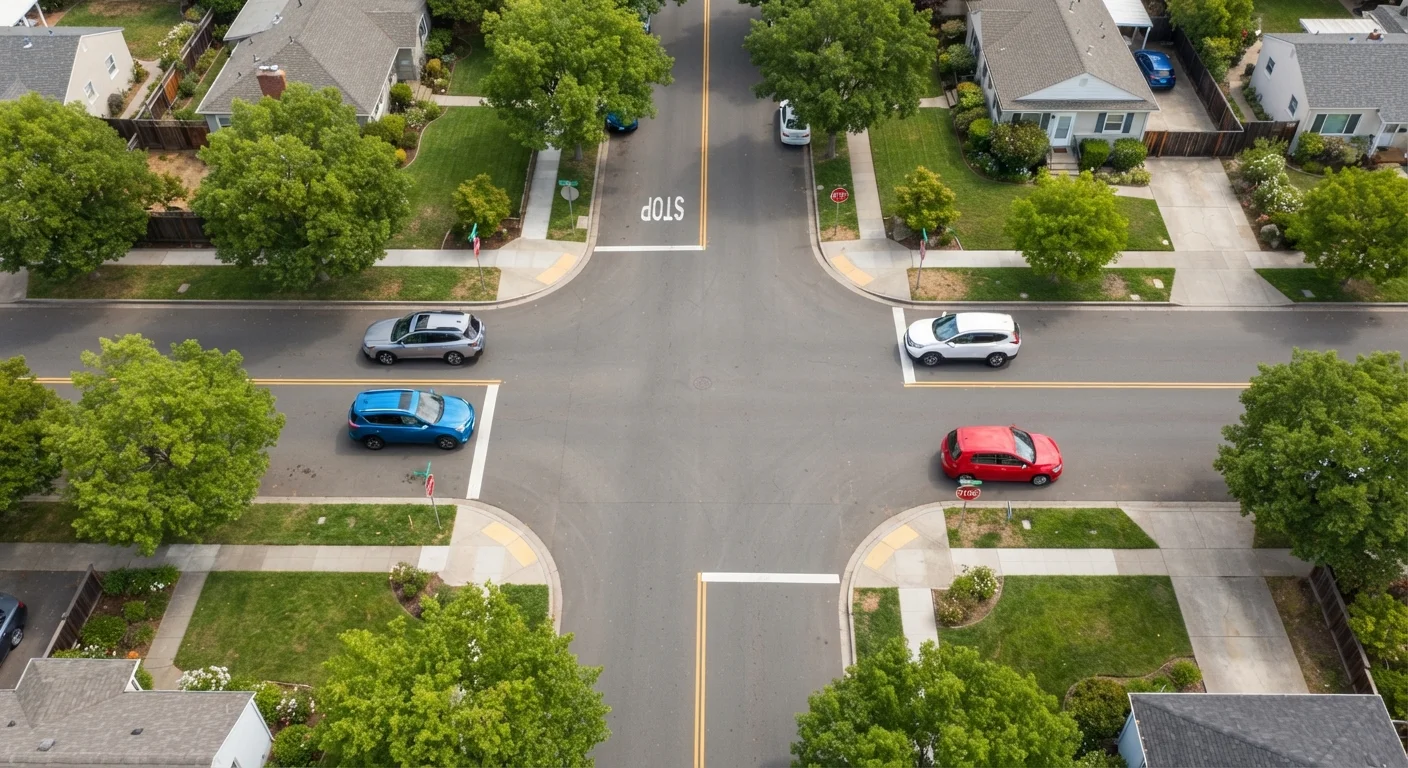
Photo credit: ProximityFinds.com | One-stop Reading Source
In this article
Four-way stops trip up even experienced drivers. Here's a clear breakdown of the right-of-way rules and how to handle common edge cases.
Key Takeaways
- The first driver to come to a complete stop at a four-way has the right-of-way.
- When two cars arrive simultaneously, the driver on the left yields to the driver on the right.
- Eye contact and small gestures help resolve ambiguous situations safely.
- Turning vehicles must always yield to oncoming traffic going straight.
- Never wave another driver through - it can create confusion and shift liability.
Why Four-Way Stops Cause So Much Confusion
Four-way stops - also called all-way stops - are one of the most common sources of driver uncertainty in the US. Unlike a traffic light, they rely entirely on driver judgment and a shared understanding of right-of-way rules. When that shared understanding breaks down, the intersection stalls, tempers rise, or worse, two cars try to move at the same time.
Part of the problem is that these rules aren't reviewed often after the initial driver's test. Many drivers operate on habit and instinct rather than clear knowledge. For a broader look at traffic laws that get misread regularly, see traffic laws drivers routinely misunderstand.
The good news: the rules are straightforward once you know them. Here's what actually governs who goes first.
What you will need
The Right-of-Way Rules, Step by Step
Follow these steps every time you approach an all-way stop. They apply in every US state, though minor local variations can exist - always defer to posted signs or a traffic officer's directions if present.
Come to a complete stop behind the line
Slow down well in advance and stop with your front bumper at or behind the painted stop line - or, if there's no line, at the edge of the intersection. A full stop means zero forward motion, even briefly.
Note who arrived before you
Scan the other three approaches. The driver who stopped first has the right-of-way and should go first. If someone clearly arrived before you, wait - even if it feels slow.
Apply the right-side rule for simultaneous arrivals
If you and another driver reached the stop at the same moment, yield to the driver on your right. This rule applies any time two vehicles arrive close enough together that order is unclear.
Yield when turning left across oncoming traffic
If you intend to turn left, you must yield to any oncoming vehicle going straight through - even if you arrived first. Turning movements always give way to straight-through traffic from the opposite direction.
Signal, make eye contact, then proceed
Use your turn signal before moving so other drivers know your intentions. Make brief eye contact with the nearest driver to confirm they see you, then move steadily and at a reasonable speed through the intersection.
Never Assume the Other Driver Knows the Rules
Even when you have the right-of-way, always verify that the other car has actually stopped before you commit to moving. Right-of-way determines who should go - it doesn't guarantee the other driver will yield. Treat your own eyes as the final check.
Edge Cases and How to Handle Them
Even with the rules down, real intersections throw curveballs. Here are the most common tricky situations:
- Three or four cars arrive at once: Work around the intersection clockwise - each driver to the right has priority. Take it slowly and make eye contact.
- You're turning left, another car is going straight from the opposite side: You arrived first, but the straight-traveling car still has priority over your left turn. Wait for them to clear before proceeding.
- Someone waves you through: Don't automatically go. That driver cannot legally grant you right-of-way, and another vehicle may be approaching that neither of you has accounted for. Acknowledge the gesture, then verify it's actually clear before moving.
- A large vehicle or truck is present: Give extra space and time. Trucks take longer to accelerate through the intersection. Patience here prevents a close call.
For more on how intersection design affects crash rates, roundabouts vs. traditional intersections breaks down the data clearly.
When in Doubt, Wait a Beat
If you genuinely can't tell whose turn it is, a one-second pause almost always resolves it - another driver will move, making the order clear. A brief hesitation costs very little time and prevents a lot of potential conflict.
Habits That Make Every Four-Way Safer
Beyond the rules, a few consistent habits dramatically reduce the chance of a mix-up:
- Come to a full stop - not a rolling slow-down. This is both legally required and what establishes your arrival order.
- Make eye contact with other drivers before moving. A brief glance confirms mutual awareness.
- Move decisively once it's your turn. Hesitation after you've been given the go-ahead creates a second wave of confusion.
- Keep a safe following distance as you approach so you have time to read the intersection. See the three-second rule and spacing habits for how to apply this consistently.
Staying alert at low-speed intersections is just as important as on the highway. Following too closely before a stop sign leaves you less time to react if the car ahead hasn't fully cleared the intersection.

Author
Automotive Editorial Team
Automotive Editorial Team is the collective byline for our editorial team and contributor network. Articles published under this byline or an editorial pen name are researched, written, and reviewed according to our editorial standards for clarity, consistency, and independence before publication.
View all articles →