
Fixed-Rate vs. Adjustable-Rate Mortgages: Which Structure Fits Your Situation
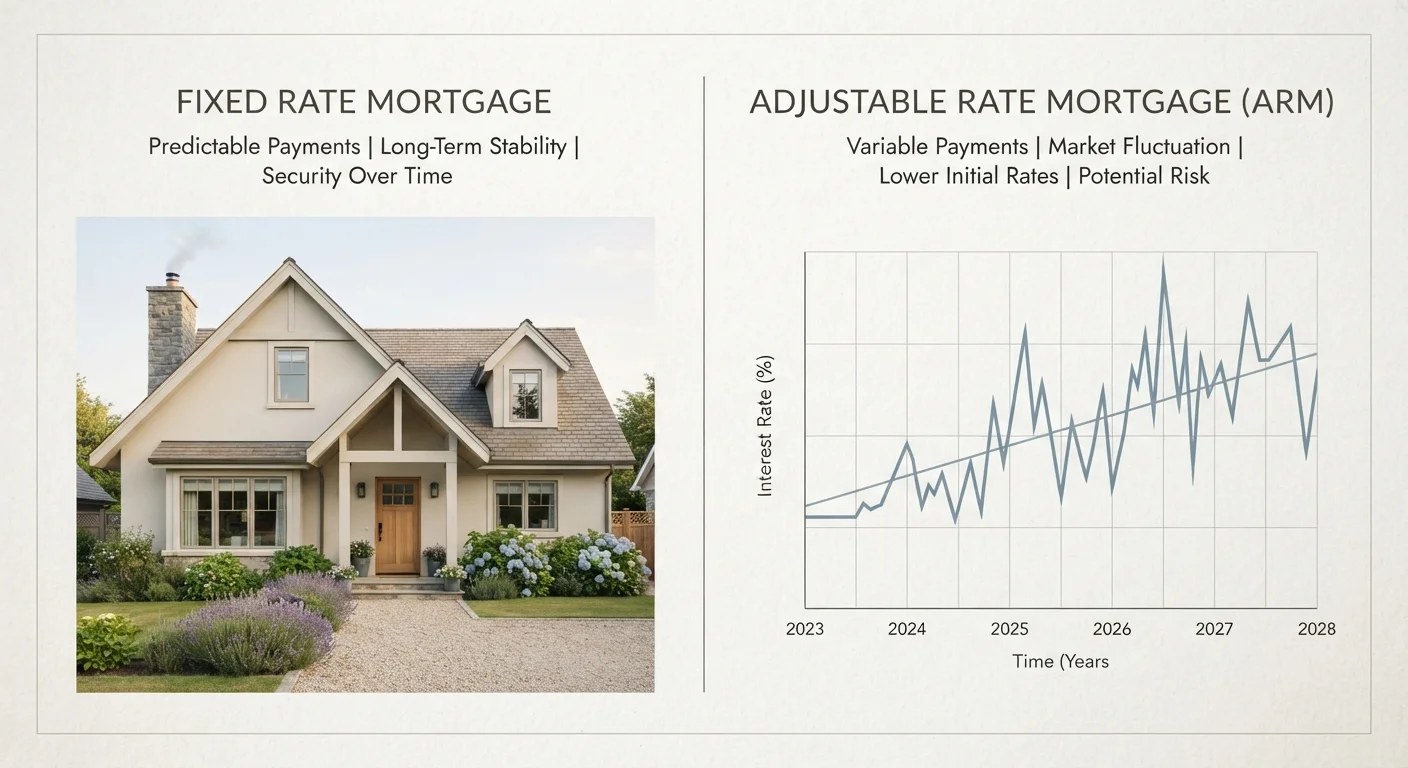
Photo credit: ProximityFinds.com | One-stop Reading Source
In this article
Understand how fixed and adjustable mortgage rates work, what each costs over time, and which conditions favor one over the other.
Key Takeaways
- Fixed-rate mortgages lock in your interest rate for the entire loan term, providing payment certainty.
- Adjustable-rate mortgages offer lower initial rates that reset periodically based on a market index.
- ARMs carry rate caps that limit how much your payment can increase at each adjustment and over the life of the loan.
- Your expected length of homeownership is one of the most important factors in choosing between the two structures.
- Both loan types are available in conventional and government-backed program formats.
How Each Mortgage Structure Works
A fixed-rate mortgage (FRM) carries the same interest rate from the first payment to the last. Whether your loan term is 15, 20, or 30 years, the rate set at closing never changes. Your principal and interest payment stays identical every month, making it straightforward to plan a long-term housing budget.
An adjustable-rate mortgage (ARM) starts with a fixed introductory period - commonly 5, 7, or 10 years - after which the rate adjusts periodically based on a benchmark index (such as the Secured Overnight Financing Rate, or SOFR) plus a set margin. ARMs are typically expressed as two numbers: a 5/1 ARM, for example, holds its initial rate for five years, then adjusts once per year afterward.
Both structures are available under various loan programs. For a broader look at program types, see our plain-English guide to mortgage loan types.
| Criterion | Fixed-Rate Mortgage | Adjustable-Rate Mortgage |
|---|---|---|
| Interest Rate | Locked for life of loan | Fixed initially, then periodic adjustments |
| Initial Monthly Payment | Higher at origination | Lower during introductory period |
| Long-Term Payment Certainty | Complete predictability | Uncertain after fixed period ends |
| Rate Cap Protections | Not applicable | Required by federal regulation |
| Best Ownership Horizon | 10+ years | 5-7 years or fewer |
| Benefits When Rates Fall | Requires refinancing to capture savings | Adjustments can lower payment automatically |
| Risk Profile | Low payment risk | Moderate to higher payment risk |
Costs Over Time: What the Numbers Reflect
Because ARMs typically open with a lower rate than comparable fixed-rate loans, initial monthly payments are lower. That difference can be meaningful - sometimes hundreds of dollars per month - particularly in high-rate environments. However, once the fixed period ends, the rate adjusts based on prevailing market conditions, which means your payment can rise.
To protect borrowers, federal regulations require that ARMs include rate caps: limits on how much the rate can increase at each adjustment interval and over the life of the loan. A common cap structure is expressed as 2/2/5 - meaning the rate cannot rise more than 2% at the first adjustment, 2% at each subsequent adjustment, and 5% total above the initial rate.
30 years
Most common fixed-rate loan term in the US
The 30-year fixed-rate mortgage has historically been the dominant loan product among American homeowners, according to data tracked by Freddie Mac.
5/1, 7/1, 10/1
Most common ARM introductory structures
These ARM formats - representing years of fixed rate followed by annual adjustment intervals - are the structures most commonly offered by US lenders.
2/2/5
Typical ARM rate cap structure
Federal consumer protection rules require rate caps on all ARMs; the 2/2/5 structure is a common example limiting initial, periodic, and lifetime rate increases.
Over a full 30-year term, a fixed-rate mortgage will typically cost more in interest if rates remain stable or decline, but less if rates rise sharply. The math depends on how long you hold the loan and what rates do during your ownership period - neither of which can be known in advance.
Key Factors That Should Drive Your Decision
No single mortgage structure suits every buyer. These are the considerations that most directly affect which option aligns with your situation:
- Time horizon: How long you plan to stay in the home is arguably the most important variable. Buyers who anticipate moving within the ARM's fixed period rarely face an adjustment at all.
- Income stability: If your earnings are irregular - as is common for freelancers and gig workers - a predictable payment reduces financial risk. Our article on budgeting with irregular income explores how variable cash flow affects financial planning more broadly.
- Rate environment: When fixed rates are high relative to historical norms, the initial spread between ARMs and FRMs tends to widen, making ARMs comparatively more attractive. When rates are low, the spread often narrows.
- Risk tolerance: An ARM introduces uncertainty. Buyers who would face significant hardship from a higher payment should weigh whether that exposure is acceptable given their financial cushion.
Understanding the Index and Margin
When an ARM adjusts, the new rate is calculated by adding a fixed margin (set at origination) to a benchmark index such as SOFR. The index reflects broad market rates and fluctuates over time, while the margin stays constant for the life of the loan. Understanding both components helps borrowers estimate potential future payments during the adjustment phase.
The broader rent-versus-own decision is also worth revisiting if you're still weighing homeownership. See our overview of renting vs. buying a home for context on equity, flexibility, and long-term financial trade-offs.

Author
Real Estate Editorial Team
Real Estate Editorial Team is the collective byline for our editorial team and contributor network. Articles published under this byline or an editorial pen name are researched, written, and reviewed according to our editorial standards for clarity, consistency, and independence before publication.
View all articles →