
Home Organization Terms You Should Actually Know
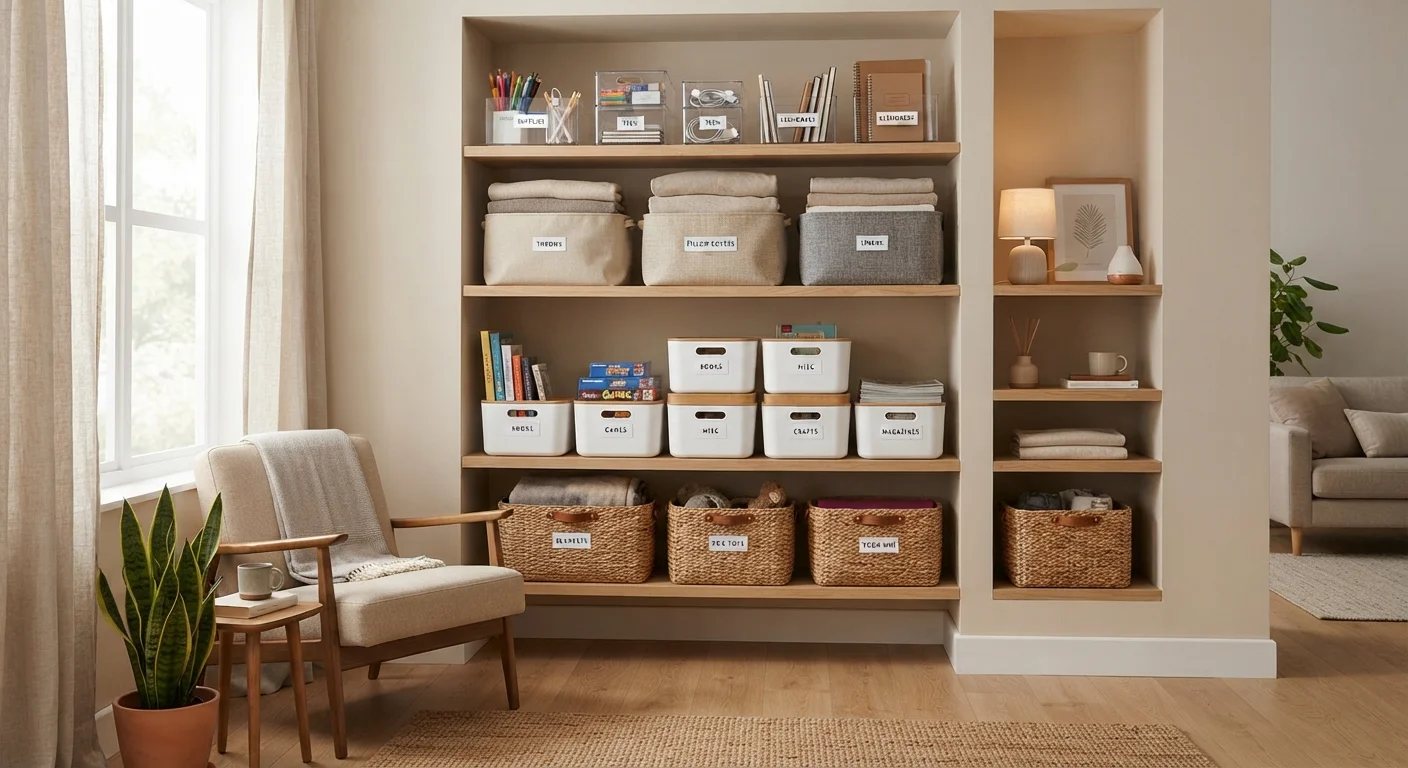
Photo credit: ProximityFinds.com | One-stop Reading Source
From 'zones' to 'capsule storage,' this reference guide explains the most commonly used home organization concepts in plain language.
Why Organization Vocabulary Matters
Home organization advice is everywhere, but the terminology can feel like a second language. Words like zones, decanting, and capsule storage show up constantly in guides and videos - yet rarely get defined. When you don't know what a concept actually means, it's hard to apply it correctly or decide whether it suits your home.
This reference breaks down the most commonly used home organization terms in plain language, so you can read any guide, watch any tutorial, and immediately put the ideas to work. Once you're comfortable with the vocabulary, the room-by-room walkthrough gives you a practical place to apply it.
Core Concepts Every Organizer Should Understand
These foundational ideas appear across virtually every organization method and space. Mastering them gives you a framework that works in any room.
Zones
A zone is a dedicated area within a room reserved for a specific activity or category of items. A kitchen might have a baking zone, a coffee zone, and a meal-prep zone - each stocked only with what belongs to that task. Zones reduce searching time and prevent unrelated items from crowding functional spaces.
The One-In, One-Out Rule
This maintenance principle holds that every time a new item enters your home, an equivalent item leaves. It keeps clutter from accumulating without requiring periodic deep purges. Applied consistently, it's one of the most effective long-term strategies for maintaining order.
Decanting
Decanting means transferring products out of their original packaging and into uniform containers - think cereal moved from the box into a clear canister. It improves visibility, maximizes shelf space, and creates visual cohesion. It works particularly well in pantries and bathroom cabinets.
Capsule Storage
Borrowed from the concept of a capsule wardrobe, capsule storage refers to keeping only a curated, minimal set of items in a given space - enough to cover all your needs with no redundancy or excess. It's especially useful in linen closets, toy storage, and kitchens where overstocking is common.
Even well-designed systems break down over time. If yours stops working, it's usually for a predictable reason - see why organized spaces stop working for a closer look.
Organization Systems Aren't One-Size-Fits-All
A method that works perfectly in a large suburban home may be impractical in a small apartment. Before adopting any system, consider your actual space constraints, household size, and daily habits. The best organization approach is the one you can realistically maintain - not the one that photographs best.

Author
Home Editorial Team
Home Editorial Team is the collective byline for our editorial team and contributor network. Articles published under this byline or an editorial pen name are researched, written, and reviewed according to our editorial standards for clarity, consistency, and independence before publication.
View all articles →