
Before You Drain Your Savings to Pay Off Debt
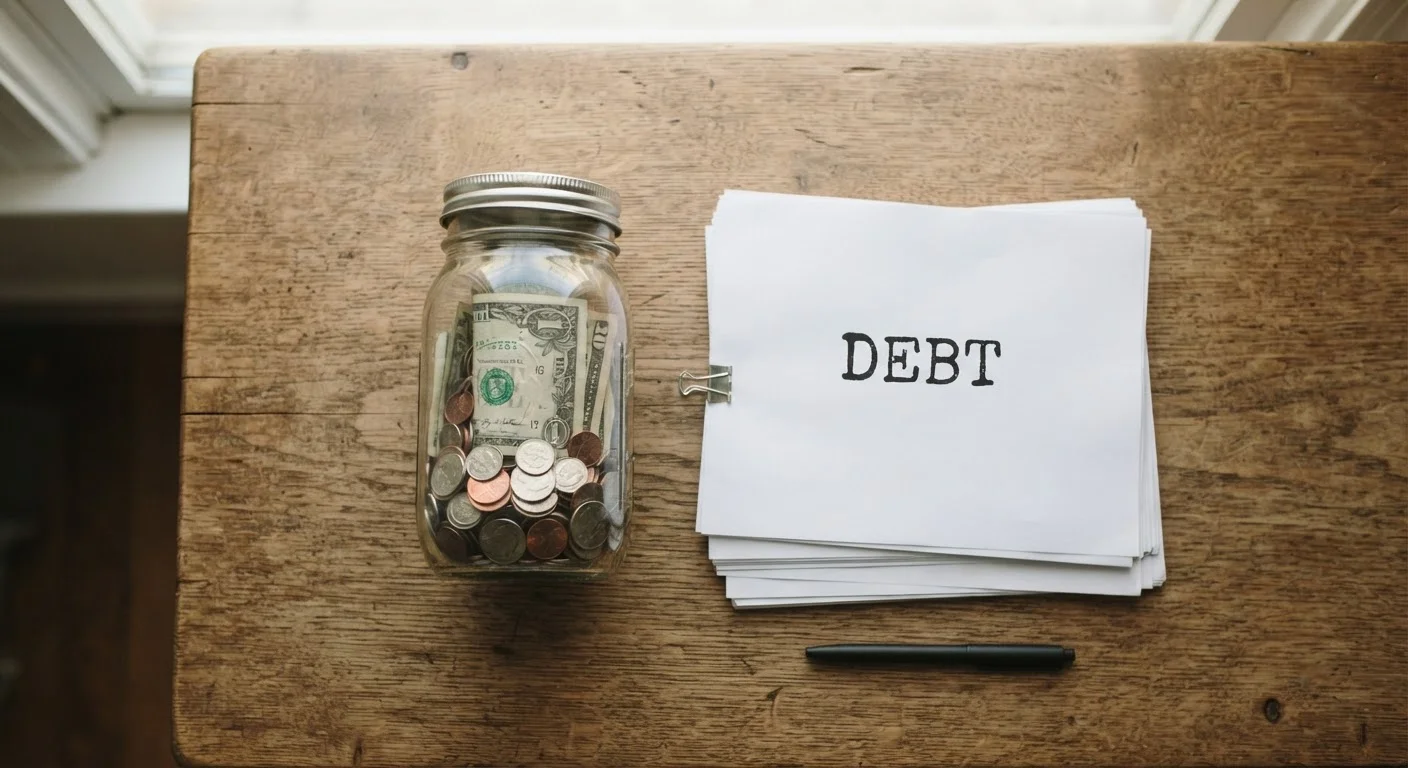
Photo credit: ProximityFinds.com | One-stop Reading Source
In this article
It seems logical to use savings to eliminate debt, but the decision involves tradeoffs around liquidity, interest rates, and financial resilience.
Key Takeaways
- Draining savings to eliminate debt removes your financial cushion against unexpected expenses.
- The math favors using savings when debt interest rates significantly exceed savings account yields.
- High-interest debt and a fully depleted emergency fund is often a worse outcome than carrying both.
- Your job stability, health, and overall cash flow should influence this decision.
- A partial paydown - keeping a minimum emergency reserve - may balance both goals effectively.
Eliminates high interest charges immediately
Credit card APRs commonly range from 18% to 27%, far exceeding typical savings account yields. Paying off that balance stops interest from compounding against you each month.
Reduces total debt cost over time
Every dollar of high-rate debt paid early saves more than a dollar in future interest. The earlier the payoff, the larger the cumulative savings.
Simplifies monthly cash flow
Eliminating a debt payment frees up recurring monthly cash that can be redirected toward rebuilding savings or covering other expenses.
Can improve credit utilization ratio
Paying down revolving credit balances lowers your credit utilization - typically a significant factor in credit scoring models - which may improve your credit profile over time.
Reduces financial stress and decision fatigue
Carrying debt has documented psychological costs. Resolving it can improve financial clarity and make it easier to maintain positive money habits going forward.
Leaves you exposed to unexpected expenses
Without savings, a single unplanned cost - medical bill, car repair, job gap - often forces new borrowing, potentially at high interest rates that recreate the problem.
Savings are illiquid once spent
Unlike a credit line, cash savings are gone once used. Rebuilding takes months or years of disciplined saving, and that time window is a period of elevated financial vulnerability.
May trigger a debt rebound cycle
Research and financial counseling experience consistently show that consumers who deplete savings to pay debt often return to similar debt levels within a few years, partly because the underlying cash-flow issues remain.
Not all debt warrants aggressive paydown
Low-rate debt - some student loans, for example - may cost less annually than what disciplined saving or investing could generate, making full payoff with savings a poor tradeoff.
Tax-advantaged savings have contribution limits
If you drain a Roth IRA or HSA to pay debt, you generally cannot restore those contributions later - you permanently lose the tax-advantaged space for that year.
Why This Decision Is Harder Than It Looks
On the surface, paying off debt with savings feels like a sound move - eliminate a liability, stop paying interest, move on. But personal finance rarely works as cleanly as a spreadsheet suggests. The real calculation involves liquidity, risk, and what happens if something goes wrong after you've zeroed out your savings account.
If you're new to navigating these competing priorities, the fundamentals of saving and debt management are a useful starting point before making any large financial moves. Understanding the tradeoffs clearly is the first step toward a decision you won't regret.
~$1,000
Emergency savings many Americans lack
According to Bankrate's annual emergency savings survey, a significant share of U.S. adults report they could not cover a $1,000 unexpected expense from savings alone.
20%+
Average credit card APR in the U.S.
Federal Reserve data has shown average credit card interest rates exceeding 20% in recent years, making high-rate revolving debt one of the most costly forms of consumer borrowing.
The Case for Using Savings to Pay Off Debt
There are legitimate, well-grounded reasons why financial educators often suggest tackling high-interest debt aggressively - including with savings.
Eliminates high interest charges immediately
Credit card APRs commonly range from 18% to 27%, far exceeding typical savings account yields. Paying off that balance stops interest from compounding against you each month.
Reduces total debt cost over time
Every dollar of high-rate debt paid early saves more than a dollar in future interest. The earlier the payoff, the larger the cumulative savings.
Simplifies monthly cash flow
Eliminating a debt payment frees up recurring monthly cash that can be redirected toward rebuilding savings or covering other expenses.
Can improve credit utilization ratio
Paying down revolving credit balances lowers your credit utilization - typically a significant factor in credit scoring models - which may improve your credit profile over time.
Reduces financial stress and decision fatigue
Carrying debt has documented psychological costs. Resolving it can improve financial clarity and make it easier to maintain positive money habits going forward.
One underappreciated benefit is psychological. Carrying debt creates ongoing stress that can affect spending behavior and decision-making. Eliminating that obligation, even at a cost to liquidity, can make it easier to focus on rebuilding savings with a clear head. For some, the motivation gained from becoming debt-free outweighs the short-term loss of a financial cushion.
The Case Against Depleting Your Savings
The risks of going savings-to-zero are significant enough that many financial professionals urge caution even when the interest rate math looks favorable.
Leaves you exposed to unexpected expenses
Without savings, a single unplanned cost - medical bill, car repair, job gap - often forces new borrowing, potentially at high interest rates that recreate the problem.
Savings are illiquid once spent
Unlike a credit line, cash savings are gone once used. Rebuilding takes months or years of disciplined saving, and that time window is a period of elevated financial vulnerability.
May trigger a debt rebound cycle
Research and financial counseling experience consistently show that consumers who deplete savings to pay debt often return to similar debt levels within a few years, partly because the underlying cash-flow issues remain.
Not all debt warrants aggressive paydown
Low-rate debt - some student loans, for example - may cost less annually than what disciplined saving or investing could generate, making full payoff with savings a poor tradeoff.
Tax-advantaged savings have contribution limits
If you drain a Roth IRA or HSA to pay debt, you generally cannot restore those contributions later - you permanently lose the tax-advantaged space for that year.
Consider what happens if you pay off $8,000 in credit card debt using your emergency fund, then face a $2,500 car repair two months later. Without savings, the likely response is to put that repair on a credit card - restarting the cycle. This pattern is explored in detail in our look at habits that quietly undermine debt payoff progress.
The Emergency Fund Minimum Worth Protecting
Many financial educators suggest keeping at least one to three months of essential living expenses in accessible savings regardless of debt levels. This threshold is a floor, not a target - the goal is to avoid the scenario where a single unexpected cost sends you back into debt. Before depleting savings entirely, calculate what that minimum looks like for your household and treat it as untouchable. For context on how savings and debt interact systematically, see our common myths about paying off debt.
How to Think Through Your Specific Situation
No single rule applies universally. The right answer depends on several intersecting factors:
- Interest rate gap: If your debt carries a 22% APR and your savings earn 4.5%, the mathematical case for paydown is strong. If the gap is narrow, the liquidity argument carries more weight.
- Income stability: Salaried workers with low job-loss risk can afford a smaller emergency buffer than freelancers or those in volatile industries.
- Debt type: High-interest revolving credit (like credit cards) is a stronger candidate for paydown than fixed, low-rate installment loans.
- Savings cushion after payoff: If paying the debt leaves you with two to three months of essential expenses, that may be acceptable. Zero is rarely acceptable.
A practical middle path is a partial paydown - reducing the debt enough to meaningfully lower interest costs while preserving a minimum emergency reserve. For a structured approach to running both goals simultaneously, see our framework on saving while carrying debt.
It's also worth evaluating whether alternatives exist before drawing down savings. Debt consolidation and structured payoff methods like those covered in the debt avalanche and snowball strategies may reduce interest costs without eliminating your financial cushion.
This article is for general informational purposes only and does not constitute personalized financial advice. Consult a licensed financial professional before making decisions specific to your situation.

Author
Finance Editorial Team
Finance Editorial Team is the collective byline for our editorial team and contributor network. Articles published under this byline or an editorial pen name are researched, written, and reviewed according to our editorial standards for clarity, consistency, and independence before publication.
View all articles →