
Stocks vs. Bonds: What Each One Actually Represents
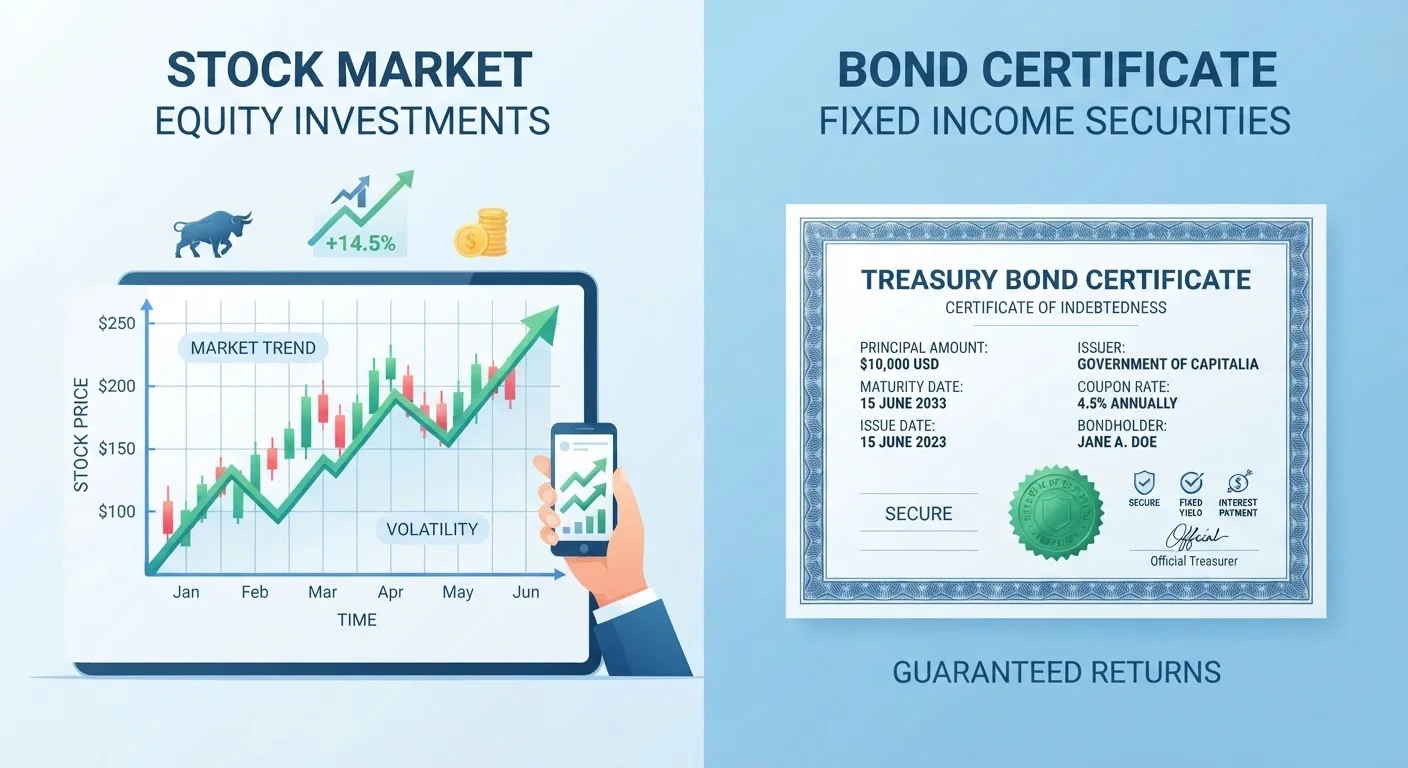
Photo credit: ProximityFinds.com | One-stop Reading Source
In this article
Stocks and bonds behave differently and serve different roles in a portfolio. Here's a clear breakdown of what sets them apart.
Key Takeaways
- A stock represents partial ownership in a company; a bond represents a loan made to an issuer.
- Stocks historically offer higher long-term returns but come with greater price volatility.
- Bonds typically provide regular interest payments and return principal at maturity.
- Both assets serve different roles, and most portfolios benefit from holding some combination of each.
- Your ideal mix depends on your time horizon, risk tolerance, and financial goals.
What a Stock Actually Is
When a company wants to raise money, one option is to sell small pieces of ownership to the public. Each piece is a share of stock - sometimes called equity. If you buy shares, you become a part-owner of that company, however small your slice may be.
As a shareholder, your financial outcome is tied directly to the company's performance. If the business grows and becomes more profitable, the value of your shares may rise. If the company struggles, the share price can fall - sometimes sharply. You may also receive dividends, which are periodic distributions of profit, though not all companies pay them.
Stocks carry no fixed repayment schedule. There is no guaranteed return of your original investment. That asymmetry - unlimited upside, potential loss of principal - defines equity investing. For a deeper look at how these terms fit the broader investing landscape, see the plain-English investing glossary.
What a Bond Actually Is
A bond works like a formal loan. When you buy a bond, you are lending money to an issuer - a corporation, a municipality, or the federal government - in exchange for a written promise. That promise has two main components: regular interest payments (called the coupon) and the return of the original loan amount (called the principal or face value) on a set date called the maturity date.
Because the terms are fixed upfront, bonds are often called fixed-income securities. You generally know exactly what you will receive if you hold the bond to maturity. That predictability is what makes bonds appealing to investors who need reliable cash flow or want to reduce the uncertainty in their portfolio.
Bonds are not without risk. If an issuer defaults - fails to make payments - you may lose money. And if you sell a bond before maturity, its market price may be higher or lower than what you paid, depending on interest rate movements.
Bond Prices and Interest Rates Move Opposite
One concept that surprises many new investors: when prevailing interest rates rise, the market price of existing bonds typically falls, and vice versa. This happens because newer bonds issued at higher rates become more attractive than older, lower-rate ones. If you hold a bond to maturity, this price fluctuation does not affect your scheduled payments - but it matters if you sell early.
How They Compare Side by Side
Understanding the structural difference between stocks and bonds clarifies why they often behave differently in the same market environment. The table below summarizes the core distinctions.
| Criterion | Stocks | Bonds |
|---|---|---|
| What you become | Part-owner of a company | Creditor (lender) to an issuer |
| Return type | Price appreciation + dividends | Fixed interest (coupon) payments |
| Principal repayment | No guarantee | Returned at maturity (if no default) |
| Typical volatility | Higher | Lower |
| Long-term growth potential | Generally higher | Generally lower |
| Income predictability | Variable or none | Scheduled and defined |
| Risk profile | Market risk, company risk | Credit risk, interest rate risk |
Historically, U.S. stocks have delivered higher long-term average annual returns than bonds - though with considerably more volatility. Bonds have tended to hold their value better during equity market downturns, which is part of why holding both is a foundational concept in portfolio construction. For a deeper look at how to balance these two asset classes, see asset allocation explained.
Using Stocks and Bonds Together
Most investment professionals treat stocks and bonds as complementary rather than competing choices. The reasoning: they often respond differently to the same economic conditions. When corporate earnings drive stock prices up, bond yields may not follow at the same pace - and vice versa.
~10%
U.S. stock market average annual return (historical)
The S&P 500 index has historically averaged roughly 10% annual returns before inflation over the long term, though individual years vary widely and past results do not guarantee future performance.
~4-6%
Typical long-term U.S. bond return (historical)
U.S. Treasury and investment-grade bond returns have historically been lower than equities but more stable, making them a common counterweight in diversified portfolios.
60/40
Classic stock-to-bond portfolio ratio
The 60% stocks / 40% bonds allocation has long been a benchmark for moderate-risk portfolios, though its appropriateness depends entirely on individual circumstances and goals.
The proportion of each you hold - your asset allocation - is one of the most consequential decisions you will make as an investor. A portfolio heavily weighted toward stocks accepts more short-term volatility in pursuit of long-term growth. One weighted toward bonds prioritizes stability and income over aggressive appreciation.
There is no universal right answer. Younger investors with decades before retirement are commonly advised to carry more equity exposure, while those closer to drawing on their savings may benefit from shifting toward bonds. But individual circumstances vary widely, and this is general educational context - not personalized advice. Consult a licensed financial adviser to determine what allocation aligns with your specific goals, timeline, and risk tolerance.
When you are ready to explore how different fund structures provide exposure to these assets, the comparison of index funds vs. actively managed funds is a natural next step.
This article is for general informational and educational purposes only and does not constitute personalized financial, investment, tax, or legal advice. Consult a qualified financial professional before making investment decisions.

Author
Finance Editorial Team
Finance Editorial Team is the collective byline for our editorial team and contributor network. Articles published under this byline or an editorial pen name are researched, written, and reviewed according to our editorial standards for clarity, consistency, and independence before publication.
View all articles →