
Whole Foods vs. Ultra-Processed Foods: What the Research Shows
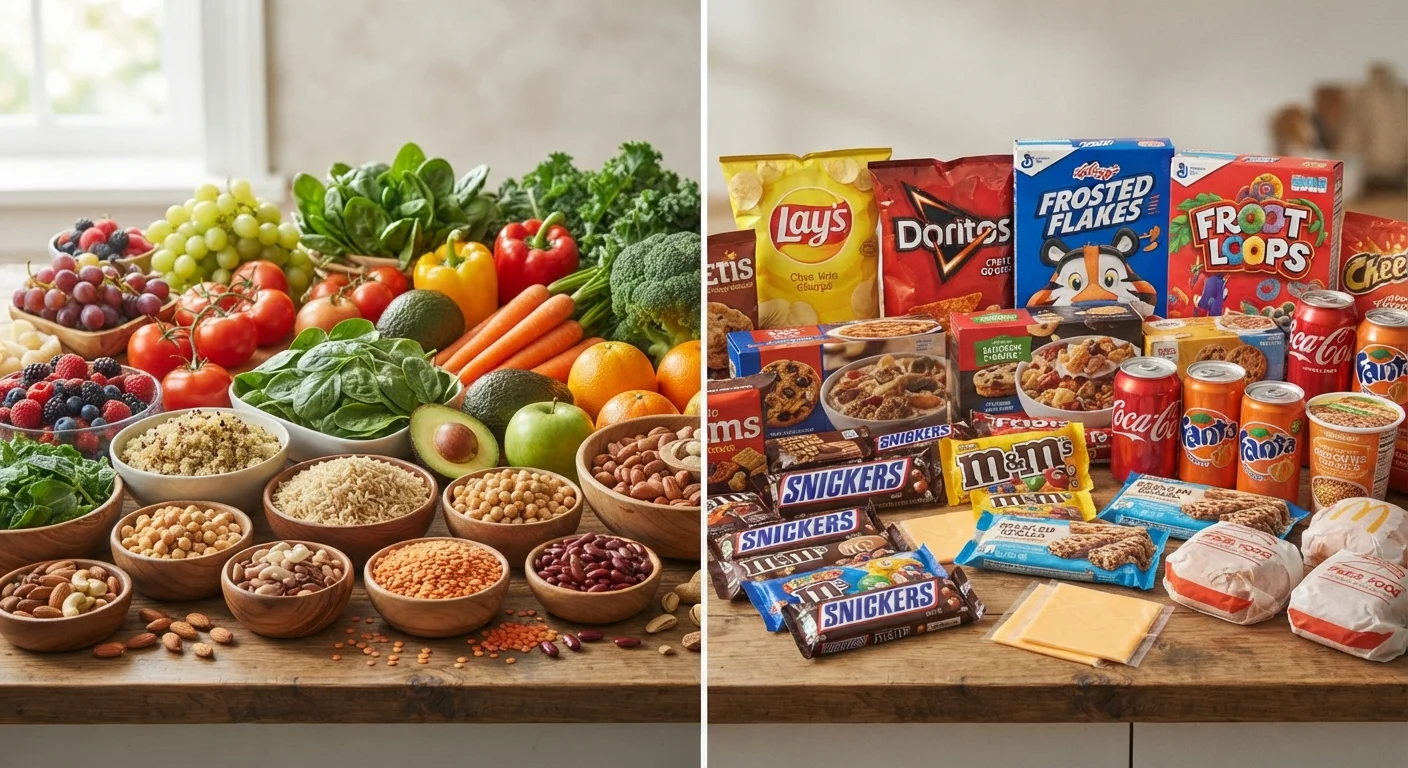
Photo credit: ProximityFinds.com | One-stop Reading Source
In this article
Ultra-processed foods make up a large share of American diets. See how they compare to whole foods across key nutritional measures.
Key Takeaways
- Ultra-processed foods account for roughly 57% of total daily calorie intake in the average American diet.
- Whole foods deliver fiber, vitamins, and phytonutrients largely absent in ultra-processed alternatives.
- Multiple large studies link high ultra-processed food consumption to increased risk of cardiovascular disease and obesity.
- The NOVA classification system is a widely used research framework for categorizing foods by degree of processing.
- Shifting even a portion of daily calories from ultra-processed to whole foods can meaningfully improve dietary quality.
Defining the Two Ends of the Food Processing Spectrum
Not all food processing is harmful. Freezing vegetables, pasteurizing milk, and milling grain are all forms of processing that can preserve safety and nutritional value. What researchers flag as a public health concern is a different category entirely: ultra-processed foods.
The most widely used classification system in nutrition research is NOVA, developed by epidemiologists at the University of São Paulo. It sorts foods into four groups based on the extent and purpose of processing. NOVA Group 1 covers unprocessed or minimally processed foods - fresh produce, eggs, plain meat, legumes. Group 4, ultra-processed foods, includes industrially formulated products containing ingredients rarely found in a home kitchen: emulsifiers, flavor enhancers, artificial colorings, hydrogenated oils, and high-fructose corn syrup.
Whole foods, as commonly understood, align with Groups 1 and 2 in the NOVA system - they are foods in their natural or near-natural state, with little modification beyond what's needed for safety or basic preparation. For a foundational overview of how nutrition researchers think about food composition, see our comprehensive nutrition science overview.
| Criterion | Whole Foods | Ultra-Processed Foods |
|---|---|---|
| Fiber content | Naturally high in dietary fiber | Typically low; often fiber-stripped |
| Micronutrient density | Rich in vitamins, minerals, phytonutrients | Low; some synthetic vitamins added |
| Added sugars | Minimal to none | Often high; major contributor in US diets |
| Sodium levels | Naturally low | Frequently high due to preservation |
| Ingredient complexity | Few, recognizable ingredients | Many additives, emulsifiers, flavor agents |
| Satiety response | Generally higher due to fiber and protein | Lower; may encourage overconsumption |
| Association with disease risk | Linked to reduced chronic disease risk | Associated with higher cardiovascular and metabolic risk |
What the Research Actually Shows
The evidence base connecting ultra-processed food consumption to adverse health outcomes has grown considerably over the past decade. A landmark 2019 randomized controlled trial by Kevin Hall and colleagues at the National Institutes of Health found that participants assigned an ultra-processed diet consumed significantly more calories per day and gained weight compared to those on a minimally processed diet - even when both groups had access to equivalent macronutrient profiles. This suggested something beyond simple calorie math was at play.
Large-scale observational studies, including the NutriNet-Santé cohort in France and data from the UK Biobank, have associated higher ultra-processed food intake with elevated risks of cardiovascular disease, type 2 diabetes, certain cancers, and all-cause mortality. These are associations, not confirmed causal chains, and researchers continue to investigate the mechanisms involved.
~57%
Share of US calories from ultra-processed foods
Research published in BMJ Open (Martínez Steele et al.) estimated that ultra-processed foods account for approximately 57% of total daily energy intake in the US diet.
10%+
Higher all-cause mortality risk
A study published in JAMA Internal Medicine found that each 10-percentage-point increase in ultra-processed food consumption was associated with over a 10% higher risk of all-cause mortality.
~500 kcal/day
Extra calories consumed on ultra-processed diet
In the NIH randomized controlled trial by Hall et al. (2019), participants on an ultra-processed diet consumed roughly 500 additional calories per day compared to those on a minimally processed diet.
One proposed mechanism involves the displacement of fiber and micronutrients. Ultra-processed foods tend to be low in dietary fiber - a nutrient many Americans already underconsume. Fiber supports gut microbiome diversity, blood sugar regulation, and cardiovascular health. Whole foods like legumes, vegetables, and whole grains are primary fiber sources. For more on this gap, see our article on key nutrient shortfalls in American diets.
Practical Implications for Everyday Eating
Understanding this research isn't about achieving a perfect diet or eliminating every packaged food. It's about making informed trade-offs. The term ultra-processed does not mean every convenience food is equally harmful - context, frequency, and overall dietary pattern matter more than any single food choice.
Some practical considerations worth keeping in mind:
- Label reading helps, but has limits. A long ingredient list with unfamiliar additives is a reasonable signal that a product falls into the ultra-processed category. Ingredient order and the presence of added sugars, sodium, and refined starches also provide useful context.
- Whole food substitutions don't have to be expensive. Dried beans, canned tomatoes, oats, eggs, and frozen vegetables are whole or minimally processed foods that are generally affordable and widely available.
- Dietary patterns matter more than individual foods. Researchers consistently find that overall dietary quality - not the occasional processed snack - drives health outcomes over time.
Being aware of the subtle ways processed foods can displace more nutritious options is also valuable. Our article on dietary patterns that quietly undermine healthy eating explores how this plays out in practice. When you're ready to act on this knowledge in a store setting, our nutrition-minded grocery shopping guide offers a practical framework.
This article is for general informational and educational purposes only and is not a substitute for professional medical or dietary advice. Consult a qualified healthcare provider or registered dietitian for guidance specific to your health needs.

Author
Health Editorial Team
Health Editorial Team is the collective byline for our editorial team and contributor network. Articles published under this byline or an editorial pen name are researched, written, and reviewed according to our editorial standards for clarity, consistency, and independence before publication.
View all articles →