
Why Your Money Loses Value Sitting in a Savings Account
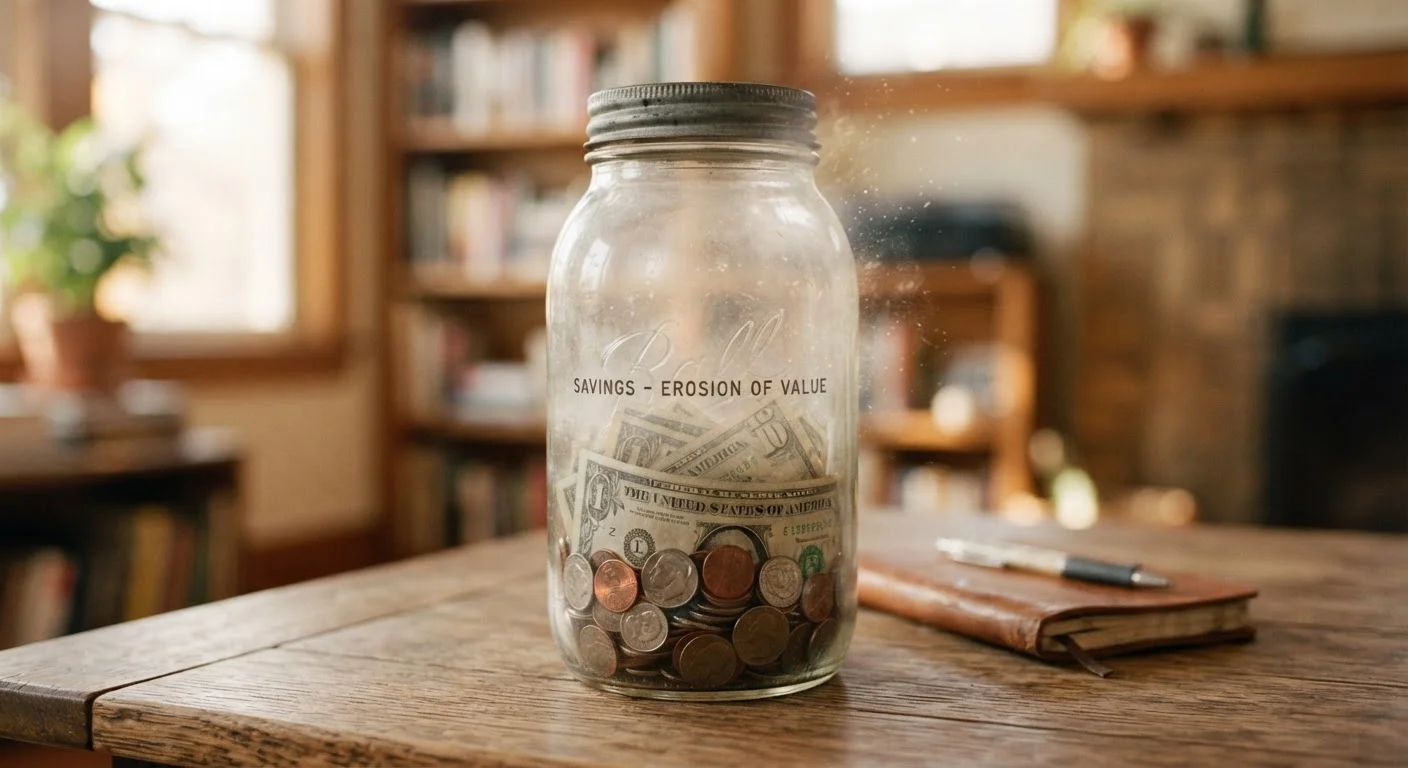
Photo credit: ProximityFinds.com | One-stop Reading Source
In this article
Inflation quietly erodes idle cash. Learn how purchasing power works and why it's a foundational reason people invest for the long term.
Key Takeaways
- Inflation steadily reduces what your money can buy, even when the dollar amount in your account doesn't change.
- Many traditional savings accounts pay interest rates well below the historical rate of inflation.
- The gap between your account's interest rate and the inflation rate is your real rate of return - which is often negative.
- Investing is largely a response to this problem: it aims to grow money faster than inflation erodes it.
- Understanding purchasing power is a foundational step toward making intentional financial decisions.
The Illusion of Safety in Idle Cash
There's a common assumption that money sitting in a savings account is protected. And in one sense, it is - federally insured accounts protect deposits up to applicable limits. But there's a second, quieter kind of risk most people overlook: the slow erosion of what that money can actually buy.
This is the concept of purchasing power - and understanding it is one of the most important steps toward financial literacy. When inflation rises faster than your account earns interest, your money's real value shrinks. The number on your statement stays flat or grows modestly, while the cost of groceries, rent, and healthcare climbs. That gap is where wealth quietly disappears.
This isn't a theoretical concern. It's the foundational reason why long-term investors follow certain core principles - chief among them, not letting money sit idle when time is on their side.
~3%
Average U.S. inflation rate over the past two decades
The Bureau of Labor Statistics has tracked CPI data showing long-run average inflation hovering near or above 3%, with significant spikes in certain periods.
0.41%
Average national savings account APY
According to FDIC data, the national average APY for traditional savings accounts has frequently remained well below 1%, creating a persistent negative real rate of return.
~26%
Purchasing power lost over 10 years at 3% inflation
At a sustained 3% annual inflation rate, $10,000 in cash loses roughly one-quarter of its real purchasing value over a decade, based on standard compound inflation calculations.
How Inflation and Interest Rates Interact
Every savings account carries an Annual Percentage Yield (APY) - the interest rate you earn on deposited funds. Traditional savings accounts at large banks have historically paid well below 1% APY. Even high-yield savings accounts, while more competitive, fluctuate with Federal Reserve policy and may not always keep pace with inflation.
The U.S. Federal Reserve targets a long-run inflation rate of around 2% annually. In practice, inflation has sometimes run significantly higher. When your savings account earns 0.5% and inflation runs at 3%, your real rate of return - your interest rate minus inflation - is approximately -2.5%. You're technically earning interest, but losing ground in terms of what that money can purchase.
It's worth understanding the structural differences at play. High-yield savings accounts differ from traditional ones in meaningful ways, but neither is designed to be a long-term wealth-building vehicle on its own.
A Note on FDIC Insurance and Risk
FDIC insurance protects depositors against bank failure - up to $250,000 per depositor, per insured bank, per ownership category. This is a meaningful protection. However, FDIC insurance does not protect against the loss of purchasing power caused by inflation. These are two distinct types of risk, and both deserve consideration when deciding where to hold money.
Why This Is the Core Argument for Investing
Investing, at its most basic level, is a response to inflation. By putting money into assets - broadly diversified across equities, bonds, or other vehicles - investors seek returns that outpace inflation over time. This is not about speculation; it's about preserving the real value of money across years or decades.
This is also why your savings rate matters so deeply. Saving a high percentage of income is important, but where that money goes matters equally. Cash that sits untouched for twenty years loses a significant portion of its real value - while that same cash, invested patiently, has historically had the opportunity to grow.
None of this means savings accounts have no role. Emergency funds, short-term goals, and liquidity needs are legitimate reasons to hold cash. The key distinction is time horizon and purpose. Money you will need within a year belongs in a safe, liquid account. Money you won't touch for a decade is, in most cases, poorly served by a savings account alone.
Making Sense of the Numbers in Practice
Consider a simplified illustration: $10,000 left in an account earning 0.5% annually for 10 years grows to roughly $10,511 in nominal terms. But if inflation averages 3% annually over that same period, the real purchasing power of that $10,511 is equivalent to about $7,800 in today's dollars. You gained $511 on paper - and lost over $2,000 in real buying power.
This compounding erosion is why financial educators consistently frame investing as a long-term necessity, not a luxury or gamble. The risk of investing is real and should never be minimized. But the risk of not investing - the quiet, invisible loss of purchasing power - deserves equal attention.
Understanding these dynamics is also part of a broader picture. Behavioral patterns, spending habits, and structural barriers all shape how Americans build - or fail to build - financial security. If you've ever wondered why saving feels so difficult for so many households, the psychology behind that struggle is well-documented and worth examining alongside the mechanics of purchasing power.
This article is for general informational and educational purposes only and does not constitute personalized financial, investment, or tax advice. Consult a qualified financial professional before making decisions about your own financial situation.
“Inflation is the cruelest tax of all because it falls on everyone - especially those who think their money is safe sitting still.”
— William Bernstein, Neurologist, financial theorist, and author of widely read books on investing and financial history
Frequently Asked Questions

Author
Finance Editorial Team
Finance Editorial Team is the collective byline for our editorial team and contributor network. Articles published under this byline or an editorial pen name are researched, written, and reviewed according to our editorial standards for clarity, consistency, and independence before publication.
View all articles →