
Understanding Market Cycles: Bull Markets, Bear Markets, and What Comes Between
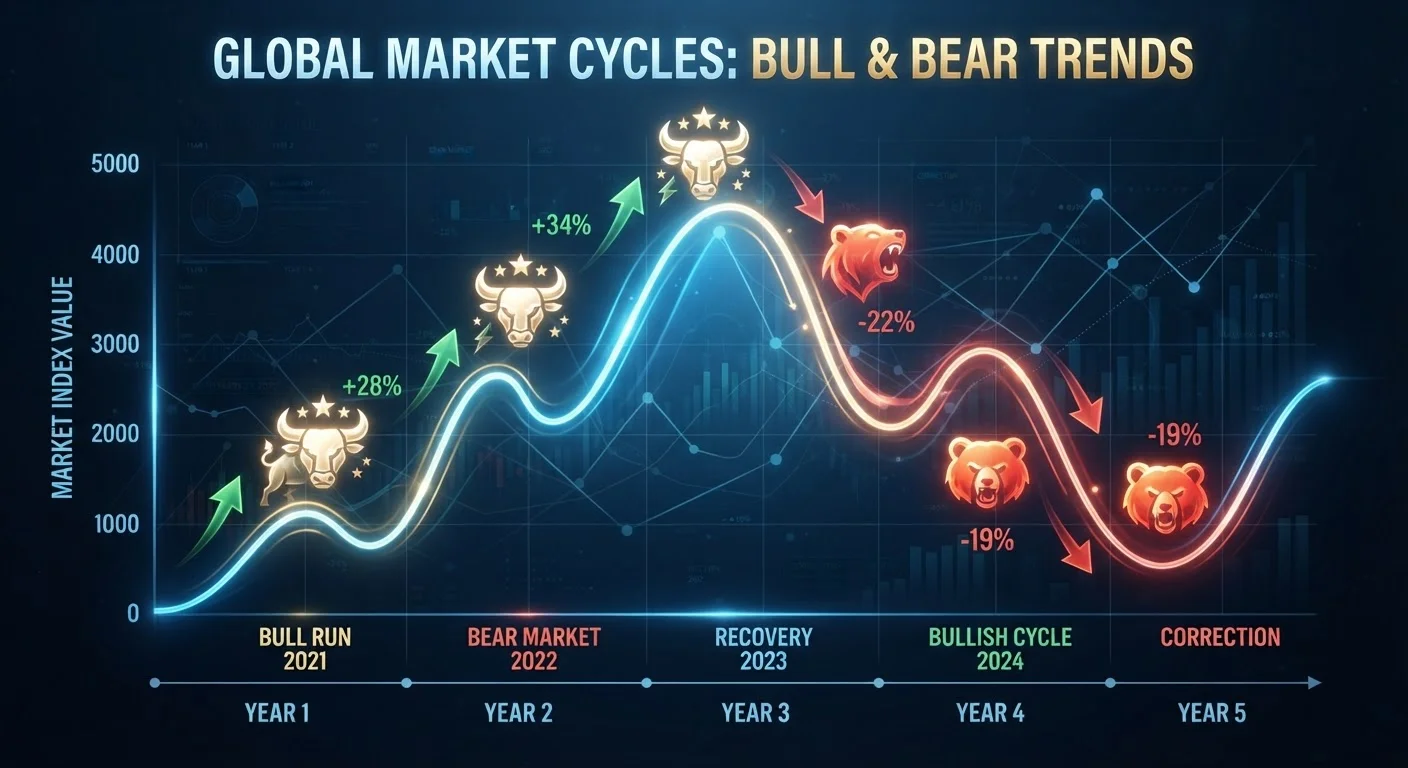
Photo credit: ProximityFinds.com | One-stop Reading Source
In this article
Markets move in cycles that every investor will eventually experience. This guide explains what these phases mean and how to think about them.
Key Takeaways
- A market cycle includes a bull phase, a bear phase, and transitional periods in between.
- Bull markets are broadly defined as a sustained rise of 20% or more from a recent low.
- Bear markets are broadly defined as a decline of 20% or more from a recent peak.
- Market corrections - drops of 10-20% - are normal and occur more frequently than bear markets.
- Staying invested through cycles, rather than timing the market, has historically benefited long-term investors.
- Understanding cycles helps investors manage emotional reactions and make more deliberate decisions.
What Is a Market Cycle?
Financial markets don't move in a straight line. They rise, fall, stall, and recover - following patterns that analysts refer to collectively as market cycles. While no two cycles are identical in length or severity, they tend to move through recognizable phases driven by investor sentiment, economic conditions, corporate earnings, and monetary policy.
Understanding these phases won't let you predict the market, but it can help you interpret what's happening when volatility strikes - and avoid the emotional decision-making that costs investors dearly. For a broader primer on the terminology you'll encounter, see our plain-English investing glossary.
~3.5 years
Average bear market duration (S&P 500, historical)
Analysis of S&P 500 history suggests bear markets have lasted considerably shorter on average than the bull markets that followed them.
~10%
Threshold defining a market correction
A drop of 10% or more from a recent high is the widely used definition of a correction, distinct from the 20% threshold for a bear market.
~6.6 years
Average bull market duration (S&P 500, historical)
Historical data on major U.S. equity bull markets suggests they have tended to last significantly longer than bear markets on average, though individual cycles vary widely.
Bull Markets Explained
A bull market is generally defined as a period in which a major market index rises at least 20% from a recent low, sustained over weeks or months. Bull markets are characterized by rising investor confidence, strong corporate earnings, low unemployment, and expanding economic output.
During a bull market, it's easy to feel that risk has all but disappeared. Asset prices climb, portfolios grow, and media coverage turns optimistic. But this environment carries its own hazards - chasing recent performance, taking on too much risk, and assuming the trend is permanent. Overconfidence is a well-documented behavioral trap that tends to peak near the end of a bull run. Our guide on behavioral traps that derail long-term investment plans explores how to recognize these patterns before they cause harm.
During a bull market, revisit your target asset allocation at least annually. Rising equity values can cause your portfolio to drift well beyond your intended risk level without any active decision on your part.
Portfolio drift - where strong equity gains push your stock allocation higher than planned - is one of the most common and overlooked sources of unintended risk accumulation.
Treat a bear market as a stress test for your actual risk tolerance, not the theoretical one you stated when opening an account. If declines make it hard to sleep, that's real information about how your portfolio should be structured.
Research in behavioral finance consistently shows that investors overestimate their tolerance for loss in calm markets and underestimate their emotional reaction when losses are real.
Bear Markets Explained
A bear market is broadly defined as a decline of 20% or more from a recent peak, sustained over at least two months. Bear markets are typically accompanied by slowing economic growth, rising unemployment, tightening credit, and widespread pessimism.
Historically, bear markets have occurred roughly every several years, with durations and depths that vary considerably. They are uncomfortable by nature - watching portfolio values fall triggers genuine psychological stress. That stress often leads to panic selling at the worst possible time, locking in losses that a patient investor might have recovered.
Panic Selling Can Permanently Impair Returns
Selling during a bear market converts paper losses into real ones and risks missing the recovery that often follows. Historically, some of the strongest single-day gains occur during or immediately after bear market periods. Missing even a handful of those days can significantly reduce long-term returns. If you find yourself tempted to exit entirely, consider speaking with a licensed financial adviser before acting.
It's worth noting that bear markets, while painful, have historically been followed by recoveries. Past performance does not guarantee future results, and individual outcomes vary - but the historical record does suggest that time in the market often matters more than timing the market.
The Phases Between: Corrections and Consolidations
Markets spend a great deal of time in territory that isn't cleanly bull or bear. Two intermediate phases are worth understanding:
- Correction: A decline of 10-20% from a recent high. Corrections are common - they occur more frequently than full bear markets - and often represent a healthy reset of valuations after a strong run. They can feel alarming in the moment but typically resolve within weeks to a few months.
- Consolidation (or sideways market): A period in which prices trade within a relatively narrow range without a clear upward or downward trend. Consolidations can last months or even years, and they often precede the next major directional move.
These middle phases are where many investors struggle most. The absence of a clear trend makes it tempting to try to read signals and act decisively - but for most long-term investors, consistency tends to outperform reactive repositioning. Explore the key principles that long-term investors tend to follow for a grounded framework.
How to Think About Market Cycles as an Investor
Knowledge of market cycles is most useful not as a trading signal, but as an emotional anchor. When you understand that drawdowns are a normal part of investing - not a sign that the system is broken - you're better positioned to stay the course.
A few principles worth internalizing:
- You cannot reliably time market cycles. Professional fund managers with vast resources consistently fail to do so. A strategy built on staying invested through cycles, combined with regular contributions, has a stronger historical track record than one built on predicting turns.
- Your time horizon matters enormously. Investors with decades ahead can afford to ride out bear markets. Those closer to needing their funds may need a more conservative allocation - which is a conversation for a qualified financial adviser, not a general article.
- Having the basics in place comes first. Before market cycles even enter the picture, foundational financial health matters. Our financial readiness checklist walks through the preparatory steps that make investing sustainable.
“The stock market is a device for transferring money from the impatient to the patient.”
— Warren Buffett, Investor and Chairman of Berkshire Hathaway
This article is for general informational and educational purposes only and does not constitute personalized financial, investment, or tax advice. Consult a qualified, licensed financial professional before making decisions based on your individual circumstances.

Author
Finance Editorial Team
Finance Editorial Team is the collective byline for our editorial team and contributor network. Articles published under this byline or an editorial pen name are researched, written, and reviewed according to our editorial standards for clarity, consistency, and independence before publication.
View all articles →